
Facilitating advance care planning in older people with mental illness

Advance care planning (ACP) involves an ongoing discussion about a person’s preferences for future healthcare, reflecting their individual values and wishes. Despite the demonstrated need and potential benefits, ACP is often overlooked in older people with mental illness. This article provides practical guidance for GPs to support ACP, including collaboration with carers and mental health services.
- Advance care planning (ACP) is rarely discussed with older people with mental illness, despite its recognised importance and benefits.
- Barriers include misconceptions about ACP, concerns about decision-making capacity and cognition, inadequate guidance on processes and lack of training.
- GPs are ideally positioned to facilitate ACP discussions with people with mental illness because of trusted relationships and continuity of care.
- A collaborative team-based approach, including patients, family or carers, mental health clinicians and other healthcare professionals, can facilitate ACP for people with mental illness and complex care needs.
- Clear, accessible documentation, supported decision-making and multidisciplinary collaboration help optimise ACP and improve patient outcomes.
Advance care planning (ACP) is an iterative process of discussing a person’s preferences for future healthcare, aligned with their individual wishes and values.1 It helps ensure that care remains person-centred, particularly if individuals lose capacity to make or communicate decisions themselves towards the end of life. An advance care directive (ACD) is a legally binding written document that records a person’s specific preferences for future healthcare.2
Psychiatric advance directives (PADs) differ from ACDs in that they are legal documents communicating an individual’s preference for future mental health treatment if they lose decision-making capacity (e.g. during an episode of mental illness).3 Not all jurisdictions in Australia have legislation for PADs, which also involve complex ethical and practical considerations.3-6 This article focuses on ACP.
It is important to distinguish between ACP and voluntary assisted dying (VAD), as the terms are often misunderstood and conflated, including by some older people with mental illness.7,8 VAD, also known as physician-assisted suicide and medical assistance in dying,refers to a legislated process whereby a person with decision-making capacity who meets strict eligibility criteria (e.g. terminal illness) can access medication to end their life.9,10 Requests for VAD cannot be included in an ACD in Australia.11 This is because ACDs come into effect when a person loses capacity, whereas access to VAD requires decision-making capacity to be retained throughout the process.11
Although ACP is widely endorsed, people with mental illness are often overlooked in its implementation.12-14 This is especially concerning given the higher burden of medical comorbidity and premature mortality in this population, as well as poorer end-of-life outcomes, such as suboptimal symptom management, reduced access to palliative care, experiences of stigma and poor co-ordination of healthcare services.15-21
This article provides a practical guide for GPs to support their involvement in ACP with older patients with mental illness. Although the Royal Australian College of General Practitioners (RACGP) has useful practice tools and a position statement on ACP, these provide general information and are not tailored to the specific needs of people with mental illness.22-24 This article addresses the unique challenges of engaging in ACP in the context of ongoing symptoms of mental illness, cognitive impairment and concerns about decision-making capacity. It also proposes greater collaboration between primary care and mental health services to overcome barriers and support practical implementation of ACP in people with mental illness. The discussion draws on recent qualitative research with older consumers (age 55 years and older) of mental health services, their carers and clinicians to inform how ACP can be effectively facilitated in general practice.8,25
Challenges to ACP in people with mental illness
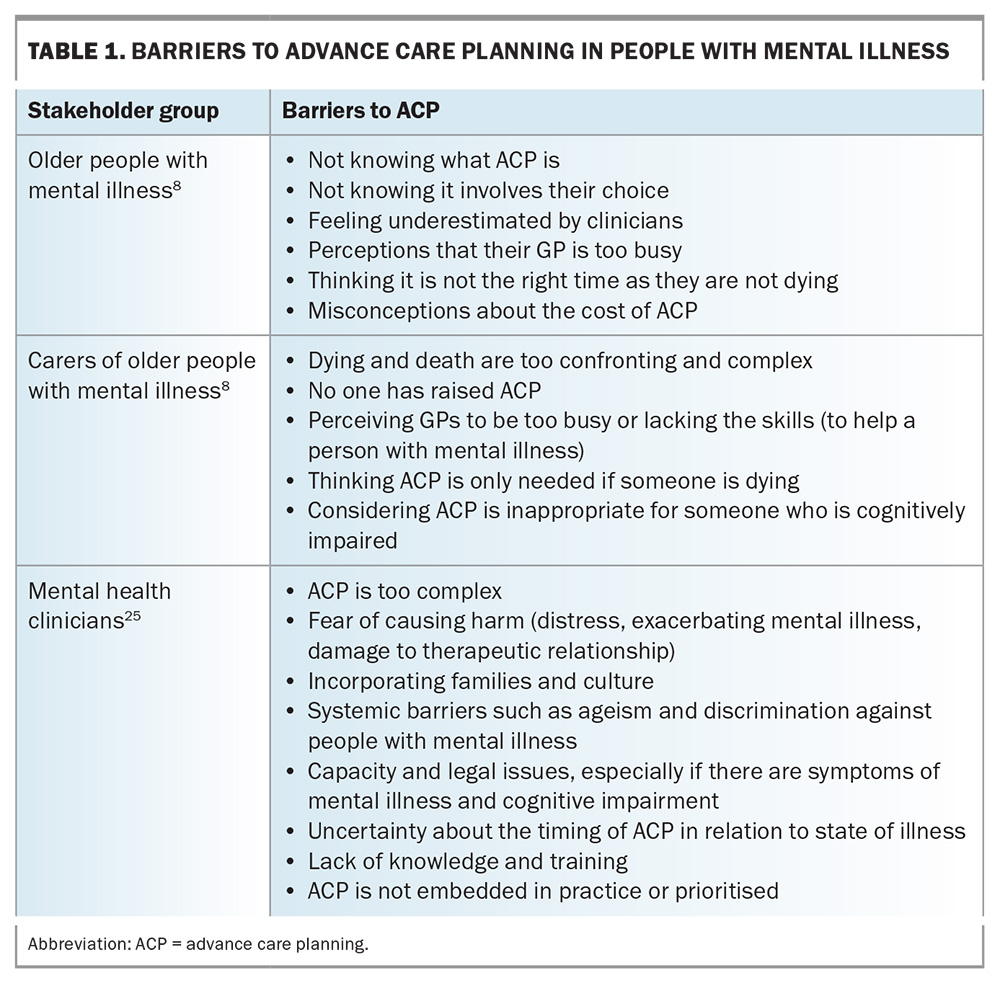
Older people with mental illness and their carers have expressed interest in ACP, recognise its benefits and want to be involved.8,14,26 Barriers to ACP exist across all healthcare settings, including clinician uncertainty about whose role it is, concerns about cognition and decision-making capacity, uncertainty about when to initiate discussions, limited time, and gaps in clinicians’ knowledge and skills.27 However, additional challenges may further limit engagement in ACP among people with mental illness.28-30 Qualitative research involving older people with mental illness, their carers and mental health clinicians in Australia has identified specific challenges (Table 1).8,25 Notably, some people with mental illness and carers perceive GPs to be too busy for ACP or lacking the skills to adapt conversations when symptoms of mental illness are present, and have indicated a preference for undertaking ACP with mental health clinicians.8 Meanwhile, mental health clinicians may not view ACP as part of their role, and report that it is not embedded in practice or prioritised.25
The RACGP recommends that GPs incorporate ACP into routine patient care, particularly for older patients (aged 75 years and older).24 The accompanying clinical and practice management guidance highlights the importance of considering capacity and mood when discussing ACP and ACDs.24 There are several high-quality resources to support GPs, such as the Advance Care Planning Improvement toolkit tailored to each state and territory, resources for ACP with residents of aged care facilities and people with dementia (https://www.advancecareplanning.org.au/professional-resources) and conversation guides.31,32 However, there are currently no dedicated resources to guide GPs in conducting ACP specifically in people with mental illness. Until recently, there were also no freely available, evidence-based resources to support mental health clinicians, consumers and carers in this area.33
Turning barriers to ACP into solutions
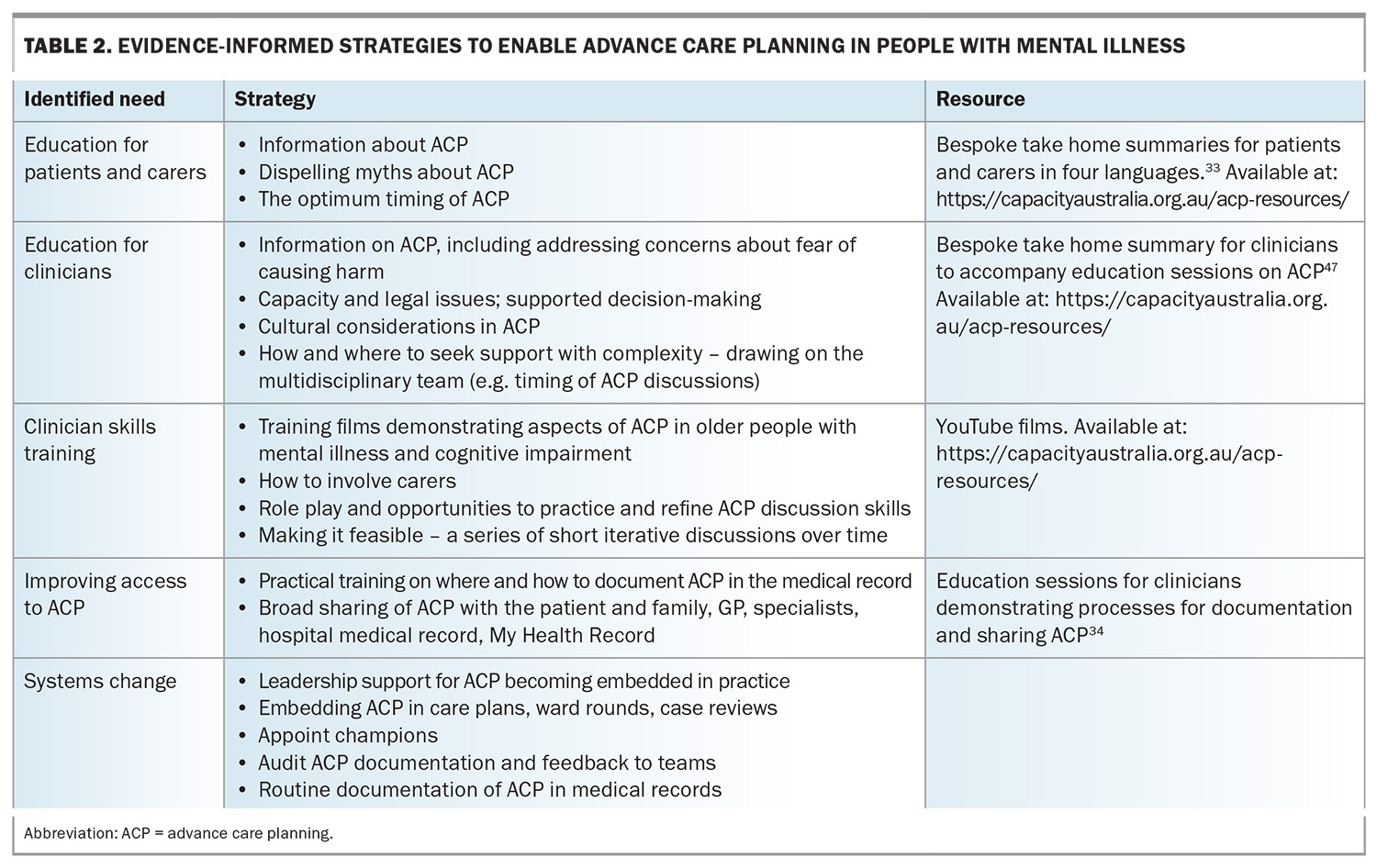
Themes regarding barriers and facilitators of ACP identified from our qualitative studies with consumers, carers and mental health clinicians informed strategies to support ACP in older people with serious mental illness, including psychosis (Table 2), and the development of targeted resources to support implementation.8,25,33,34 Given the limited knowledge and identified misconceptions about ACP and mental illness, education was recognised as essential for consumers, carers and clinicians alike.8 As no evidence-based resources specific to the needs of people with mental illness were identified, we developed some and made these freely available via the Capacity Australia website https://capacityaustralia.org.au/acp-resources.33 These one-page summaries, which address the specific needs of older people with mental illness and their carers, may also assist GPs in initiating ACP conversations.
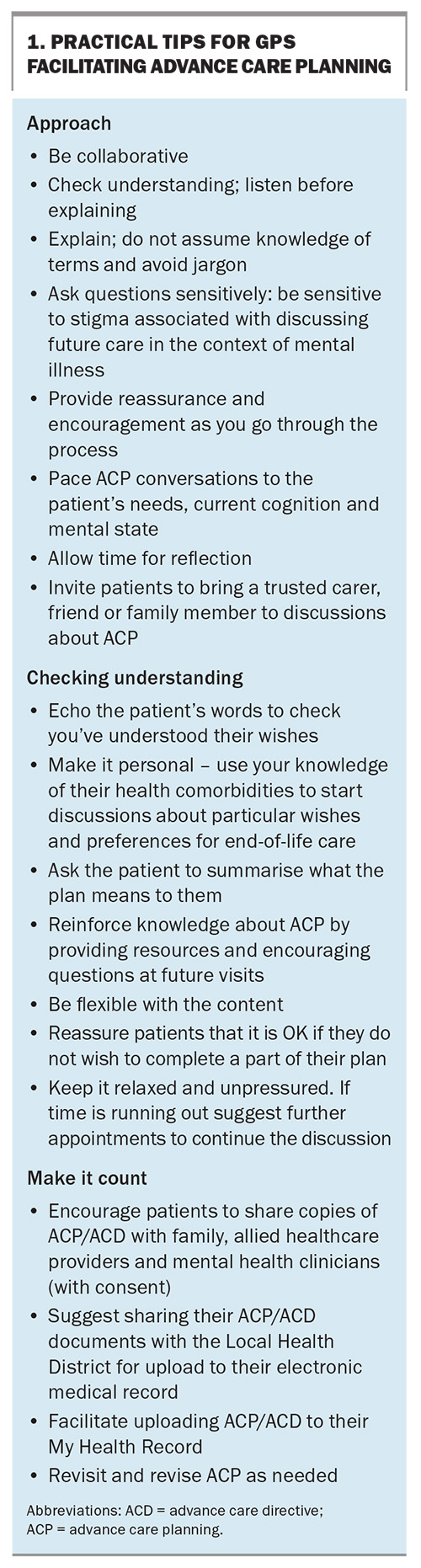
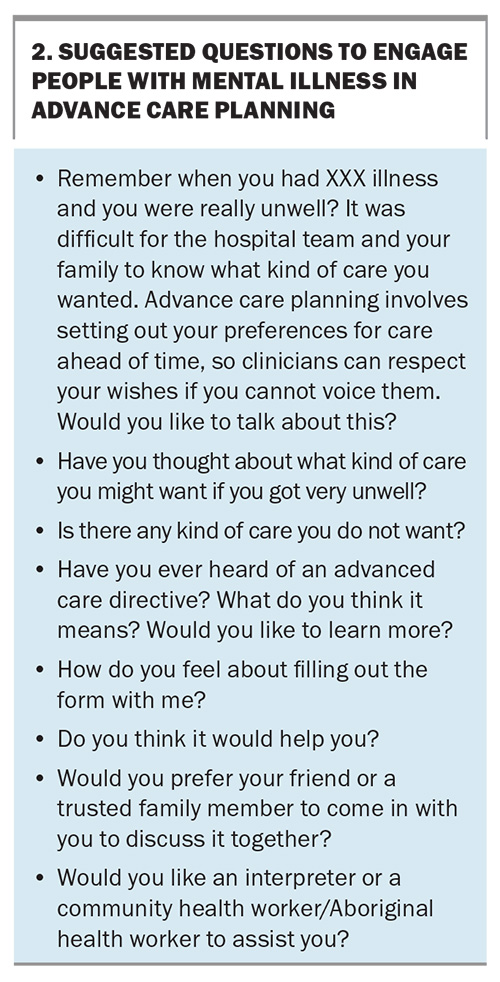
Given the identified challenges, clinician uncertainty regarding roles and patient and carer preferences, an adapted stepped-care approach is appropriate.35 This enables GPs, practice nurses and mental health clinicians to work together to facilitate ACP, particularly in more complex cases. Practical tips for ACP with people with mental illness are outlined in Box 1, and suggested conversation starters for primary care are provided in Box 2.32
Assessing decision-making capacity
Assessing decision-making capacity for ACP in people with mental illness has been identified as challenging for mental health clinicians and is also likely to be challenging for GPs.25,36 Under common law in Australia, all adults are presumed to have decision-making capacity.37 However, capacity may fluctuate or be affected by symptoms of mental illness, emotional distress and cognitive impairment.38-40 Importantly, a diagnosis of a mental illness or cognitive disorder does not equate to a loss of capacity, and people with mental illness and disability have equal recognition before the law (Article 12, Convention on the Rights of Persons with Disabilities).41 Similarly, age-based assumptions about capacity must be avoided and challenged.38
Capacity is decision-specific. Compared with ACP more generally, there is a higher threshold for completing an ACD, which is a legally binding, witnessed document that must be respected by healthcare professionals.2 An enduring guardian, family member or person responsible cannot complete an ACD on behalf of another person.2 In contrast, ACP reflects an iterative process of discussion, ideally involving the person and often their family or carers, and is not legally binding. It may involve supported decision-making. ACP can also be completed by a substitute decision-maker, taking into account the person’s wishes and preferences, even if the person lacks capacity. To assess a patient’s capacity to engage in ACP or complete an ACD, GPs need to:
- provide clear information about ACP/ACD (noting many people with mental illness are unfamiliar with these concepts)8
- assess whether the patient understands the nature, content and implications of ACP/ACD (personalised to their health condition and likely end-of-life decisions)
- assess whether the patient can weigh up the pros and cons of creating an ACP/ACD (including the implications of their choices), and
- assess the patient’s ability to communicate a choice.2,37
Capacity assessments should be documented and can be revisited as needed.42
Supported decision-making
GPs can employ several strategies to optimise decision-making capacity, including for people with mental illness. Supported decision-making involves enabling individuals to make their own decisions with appropriate assistance and to participate meaningfully in the process.43 This includes understanding the person’s values and preferences, identifying their specific support needs (e.g. use of an interpreter, involvement of a nominated carer or family member, use of hearing aids, preferred communication methods – visual, verbal or written formats) and optimising their ability to participate in the process. Supported decision-making differs from substitute decision-making, where another person makes decisions on behalf of the individual in line with what they would have wanted if they had capacity to make decisions.43
Choosing the right time to discuss ACP is crucial.25 Mental state may fluctuate, for example during periods of relapse of psychosis or depression, periods of stress (psychosocial or medical) or worsening cognitive symptoms (e.g. delirium or poorer cognition late in the day in some people with dementia). GPs may liaise with psychiatrists, mental health clinicians or aged care teams to determine optimal timing of ACP, as recommended in mental health settings.25 Practice nurses and residential aged care staff may assist with documenting the ‘values’ component of ACP.44 GPs can then discuss medical conditions and treatment options, address patient questions and witness completed documents.44 Information should be presented clearly and in plain language. ACP discussions can occur over multiple sessions to reduce burden, reinforce key information, check understanding and assess consistency of preferences over time, which is an important aspect of capacity assessment.2,37
GPs should encourage involvement of family members or nominated carers to support decision-making.8 Carers of people with mental illness have expressed an interest in being involved and recognise the benefits of ACP, including respecting the patient’s preferences, providing reassurance and relieving the burden of decision-making at end of life.8 They have also highlighted their potential roles as patient advocates, cultural brokers and sources of important contextual information, including knowledge of the person’s history and experiences (e.g. trauma), which are important for sensitive engagement.8 More generally, ACP should recognise the significance of culture on identity, practices and decision-making for individuals and their family.45
Legal considerations
For people subject to orders under the Mental Health Act or guardianship, specific considerations apply. Although a guardian cannot complete an ACD on behalf of a person, the person’s views should still be sought in ACP discussions.2 Even if the guardian has authority to make healthcare decisions, the individual should be supported to participate in ACP and express their values, wishes and preferences.
For older people under a community mental health order, capacity to engage in ACP should be assessed as detailed above. As with all individuals, they retain the right to autonomy of decision-making, unless there are reasons to question capacity. 37,46
Specific primary care settings
Community and residential aged care homes
For most well-known older patients with mental illness living in the community, GPs can engage patients in ACP using standard processes.24 However, in more complex situations, such as ongoing or fluctuating symptoms of mental illness, cognitive impairment or questions about decision-making capacity, GPs may need specialist support. This may include liaising with existing mental health clinicians or making new referrals to support optimisation of mental health and capacity assessment. Referrals to specialist services, such as older persons’ mental health, may be appropriate for people with overlapping ageing-related syndromes, frailty, multimorbidity, and co-existing cognitive and mental health conditions. Just as mental health professionals are encouraged to draw upon the expertise of multidisciplinary colleagues, GPs can similarly collaborate to support ACP for these patients.25
Many residents of residential aged care homes will be engaged in ACP early in their move into care as part of aged care quality standards.47 However, these ACP and ACD documents are often not included in the local hospital electronic medical records, rendering them inaccessible at times of greatest need.34,48 Older people engaged with public mental health or medical outpatient services should be asked whether existing ACP or ACD documentation can be uploaded to the hospital records and My Health Record, and supported to do so where needed.
Rural settings
In rural areas, the GP remains central to end-of-life care, with comparatively less involvement from palliative care, geriatric medicine, mental health and allied health services.45 The key difference in ACP for people with mental illness in rural and regional areas is access to mental health assessment and advice, particularly from specialist teams such as older persons’ mental health.
Telehealth, community partnerships and locally embedded documentation strategies can support rural GPs to initiate ACP discussions with older adults with mental illness. Inclusion of ACP documents in a patient’s My Health Record is especially important for patients in rural areas to ensure the information is available across multiple service locations (including telehealth) and across large geographical distances.45
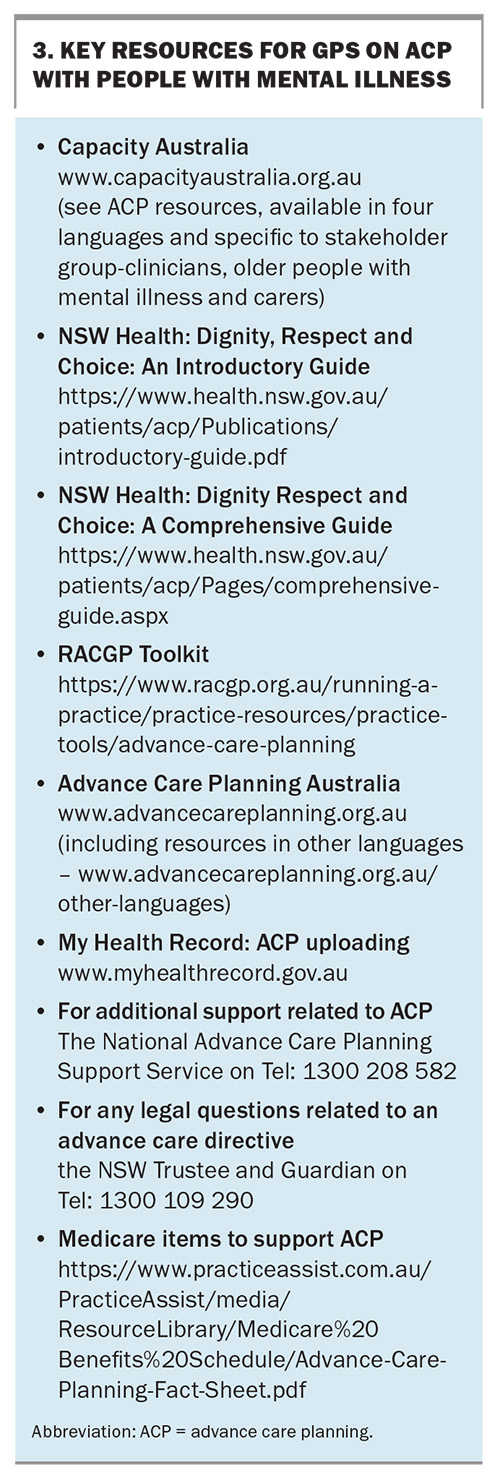
Additional resources for ACP are provided in Box 3.
Conclusion
Older people with mental illness deserve equal access to high-quality, person-centred end-of-life care. ACP provides a crucial pathway to support dignity, autonomy and clarity for patients, carers and clinicians. GPs are trusted healthcare providers who often know the patient well, both personally and medically, over many years and are therefore well-placed to start these discussions. This is in contrast with other healthcare professionals who may meet the patient for the first time in acute or emergency situations or at entry to residential aged care. Through collaboration with mental health services, GPs can lead a compassionate, inclusive approach to ACP for this population. MT
COMPETING INTERESTS: The foundational empirical research underpinning this article was supported by a philanthropic grant, the Moyira Elizabeth Vine Fund for Research in Schizophrenia, awarded to Professor Anne Wand.
References
1. Sudore RL, Lum HD, You JJ, et al. Defining advance care planning for adults: a consensus definition from a multidisciplinary delphi panel. J Pain Symptom Manage 2017; 53: 821-832 e821.
2. NSW Health. Making an advance care directive. Sydney: NSW Ministry of Health; 2023 . Available online at: https://www.health.nsw.gov.au/patients/acp/Publications/acd-form-info-book.pdf (accessed March 2026).
3. Wilson K, Purushothaman S and Kolur U. Psychiatric advance directives and consent to electroconvulsive therapy (ECT) in Australia: a legislative review and suggestions for the future. Int J Law Psychiatry 2022; 85: 101836.
4. Avila A, Leeper E. Assessment of barriers to effective use of psychiatric advance directives: Providers’ knowledge and attitudes. Psychol Serv 2022; 19: 271-282.
5. James R, Maude P, Searby A. Clinician knowledge and attitudes of mental health advance statements in Victoria, Australia. Int J Ment Health Nurs 2022; 31: 1164-1175.
6. Sellars M, Fullam R, O’Leary C, et al. Australian psychiatrists’ support for psychiatric advance directives: responses to a hypothetical vignette. Psychiatr Psychol Law 2017; 24: 61-73.
7. Scott IA, Mitchell GK, Reymond EJ, et al. Difficult but necessary conversations– the case for advance care planning. Med J Aust 2013; 199: 662-666.
8. Wand A, Karageorge A, Zeng Y, et al. The perspectives on advance care planning of older people with psychotic illnesses and their carers. Eur Geriatr Med 2025; 16: 793-805.
9. Wand APF, Hemmingsen V, Cheung G, et al. Suicide prevention in the context of ineligibility for voluntary assisted dying: emerging insights. BMC Psychiatry 2026
10. Waller K, Del Villar K, Willmott L, et al. Voluntary assisted dying in Australia: a comparative and critical analysis of state laws. UNSW Law Journal 2023; 46: 1427-1470.
11. White BP, Archer M, Haining CM, et al. Implications of voluntary assisted dying for advance care planning. Med J Aust 2024; 220: 129-133.
12. Appelbaum PS. Advance directives: stigma strikes again. Psychiatr Serv 2005; 56: 515.
13. Shalev D, Brewster K, Arbuckle MR, et al. A staggered edge: end-of-life care in patients with severe mental illness. General hospital psychiatry 2017; 44: 1-3.
14. Foti ME, Bartels SJ, Merriman MP, et al. Medical advance care planning for persons with serious mental illness. Psychiatr Serv 2005; 56: 576-584.
15. Chesney E, Goodwin GM, Fazel S. Risks of all-cause and suicide mortality in mental disorders: a meta-review. World Psychiatry 2014; 13: 153-160.
16. Reilly S, Olier I, Planner C, et al. Inequalities in physical comorbidity: a longitudinal comparative cohort study of people with severe mental illness in the UK. BMJ Open 2015; 5: e009010.
17. Baker A. Palliative and end-of-life care in the serious and persistently mentally ill population. Am Psychiatr Nurses Assoc 2005; 11: 298-303.
18. Chochinov HM, Martens PJ, Prior HJ, et al. Comparative health care use patterns of people with schizophrenia near the end of life: a population-based study in Manitoba, Canada. Schizophr Res 2012; 141: 241-246.
19. Shalev D, Fields L and Shapiro PA. End-of-life care in individuals with serious mental illness. Psychosomatics 2020; 61: 428-435.
20. Edwards D, Anstey S, Coffey M, et al. End of life care for people with severe mental illness: mixed methods systematic review and thematic synthesis (the MENLOC study). Palliat Med 2021; 35: 1747-1760.
21. Relyea E, MacDonald B, Cattaruzza C, et al. On the margins of death: a scoping review on palliative care and schizophrenia. J Palliat Care 2019; 34: 62-69.
22. Royal Australian College of General Practitioners. Advance care planning. RACGP; 2023. Available online at: https://www.racgp.org.au/running-a-practice/practice-resources/practice-tools/advance-care-planning (accessed March 2026).
23. Royal Australian College of General Practitioners. Position Statement: Advance care planning should be incorporated into routine general practice. Melbourne: RACGP; September 2012. Available online at: https://www.racgp.org.au/FSDEDEV/media/documents/RACGP/Position%20statements/Advance-care-planning-should-be-incorporated-into-routine-general-practice.pdf (accessed March 2026).
24. Royal Australian College of General Practitioners. Advance care planning should be incorporated into routine general practice. Melbourne: RACGP; 2019. Available online at: https://www.racgp.org.au/advocacy/position-statements/view-all-position-statements/clinical-and-practice-management/advance-care-planning (accessed March 2026).
25. Wand APF, Karageorge A, Zeng Y, et al. Why mental health clinicians are not engaging in advance care planning with older people with schizophrenia and other psychotic illnesses. Psychol Res Behav Manag 2024; 17: 4195-4206.
26. Foti ME, Bartels SJ, Van Citters AD, et al. End-of-life treatment preferences of persons with serious mental illness. Psychiatr Serv 2005; 56: 585-591.
27. Poveda-Moral S, Falco-Pegueroles A, Ballesteros-Silva MP, et al. Barriers to advance care planning implementation in health care: an umbrella review with implications for evidence-based practice. Worldviews Evid Based Nurs 2021; 18: 254-263.
28. Foti ME. "Do It Your Way": a demonstration project on end-of-life care for persons with serious mental illness. J Palliat Med 2003; 6: 661-669.
29. White B, Willmott L, Cartwright C, et al. Doctors’ knowledge of the law on withholding and withdrawing life-sustaining medical treatment. Med J Aust 2014; 201: 229-232.
30. Woods A, Willison K, Kington C, et al. Palliative care for people with severe persistent mental illness: a review of the literature. Can J Psychiatry 2008; 53: 725-736.
31. Advance Care Planning Australia. Advance Care Planning Improvement Toolkit: New South Wales. Melbourne: Advanced Care Planning Australia; 2022.
32. Deck E, Trevena L, Rhee J, et al. Initiating advance care planning in New South Wales general practices using a structured conversation guide. Aust J Gen Pract 2023; 52: 135-140.
33. Wand AP, Browne R, Zeng Y, et al. Development of evidence-informed educational resources for advance care planning with older people with a mental illness. Palliat Support Care 2025; 23: e187.
34. Crous K, Kanareck D, Thomas MA, et al. Evaluation of a novel educational intervention for mental health staff on advance care planning with older people with mental illness. Eur Geriatr Med 2026
35. General Practice Mental Health Standards Collaboration (GPMHSC). Working with the Stepped Care Model: Mental health services through general practice. Melbourne: The Royal Australian College of General Practitioners; 2019.
36. Jerwood JS, Phimister D, Ward G, et al. Barriers to palliative care for people with severe mental illness: exploring the views of clinical staff. European Journal of Palliative Care 2018; 25: 20-25.
37. O’Neill N and Peisah C. Capacity and the Law. 4th Edition. Australian Legal Information Institute (AustLII) Communities, 2021.
38. O’Cionnaith C, Wand APF and Peisah C. Navigating the minefield: managing refusal of medical care in older adults with chronic symptoms of mental illness. Clin Interv Aging 2021; 16: 1315-1325.
39. Trachsel M, Hermann H and Biller-Andorno N. Cognitive fluctuations as a challenge for the assessment of decision-making capacity in patients with dementia. Am J Alzheimers Dis Other Demen 2015; 30: 360-363.
40. Van Staden CW and Kruger C. Incapacity to give informed consent owing to mental disorder. J Med Ethics 2003; 29: 41-43.
41. United Nations. Convention on the rights of persons with disabilities. Geneva: United Nations: Office of the High Commissioner, Human Rights; 2006. Available online at: https://www.un.org/disabilities/documents/convention/convention_ accessible_pdf.pdf (accessed March 2026).
42. Kotze C, Roos JL and Ehlers R. End-of-life decision-making capacity in older people with serious mental illness. Front Psychiatry 2021; 12: 752897.
43. Sinclair C, Field S, Williams K, et al. Supporting decision-making: a guide for people living with dementia, family members and carers. Sydney: Cognitive Decline Partnership Centre, 2018. Available online at: https://cdpc.sydney.edu.au/wp-content/uploads/2019/06/SDM_Handbook_Online_Consumers-ReducedSize.pdf (accessed March 2026).
44. Royal Australian College of General Practitioners. Part B. Advance care planning. RACGP aged care clinical guide (Silver Book) 5th edition. Melbourne: RACGP; 2019. Available online at: https://www.racgp.org.au/silverbook (accessed March 2026).
45. Australian College of Rural and Remote Medicine (ACRRM). Position statement: end of life care and advance care planning for rural and remote communities. Brisbane: ACRRM; 2022. Available online at: https://www.acrrm.org.au/docs/default-source/all-files/college-position-statement-end-of-life-care.pdf?221104 (accessed March 2026).
46. NSW Ministry of Health. Dignity, respect and choice: Advance care planning for end of life for people with mental illness. An introductory guide. North Sydney: NSW Ministry of Health, 2015.
47. Australian Government Department of Health and Aged Care. Revised Aged Care Quality Standards: Draft for Pilot. 2023. Canberra: Australian Government Department of Health and Aged Care; 2023.
48. Sands M, Norris CJ, Varndell W, et al. Plan EARLY ED: identifying patients in the emergency department for engagement in advance care planning on discharge. Australian and New Zealand Society of Palliative Medicine. 2018.
Single article purchases are temporarily unavailable due to site maintenance.
If you would like to purchase an article during this time, please email us at [email protected] with the article details and we'll assist you directly. We'll also let you know when online purchasing is available again.
Thank you for your patience and understanding.