
Tirbanibulin: a convenient five-day field therapy for actinic keratoses
Tirbanibulin is a recently commercially released topical field therapy for actinic keratoses, delivered as a short five-day treatment course. As well as having a shorter duration of treatment, it may potentially produce milder local reactions compared with other field treatments.
- Tirbanibulin is a new topical field therapy for actinic keratoses (AKs), now released commercially in Australia.
- The TGA has approved tirbanibulin for the treatment of nonhyperkeratotic, nonhypertrophic AKs of the face or scalp in adults.
- Tirbanibulin likely has similar efficacy to other field therapies, with possibly milder local reactions.
- Given as a five-day course, tirbanibulin has a shorter treatment duration than most other field therapies.
Actinic keratoses (AKs) are often treated by Australian GPs. Adequate management of AKs is desirable for symptomatic, cosmetic and potential skin cancer preventive benefits. Although a range of field treatments exists, lengthy application regimens and uncomfortable local application site reactions mean patients may go without, or delay, treatment. Tirbanibulin is a newly available topical therapy that may be more convenient for patients because of its shorter treatment course (once-daily application for five days using single-use sachets) and potentially milder local application site reactions (including an absence of photosensitivity). This article reviews the efficacy and safety of tirbanibulin and provides practical guidance for its use.
Background
Definition and clinical features of AKs
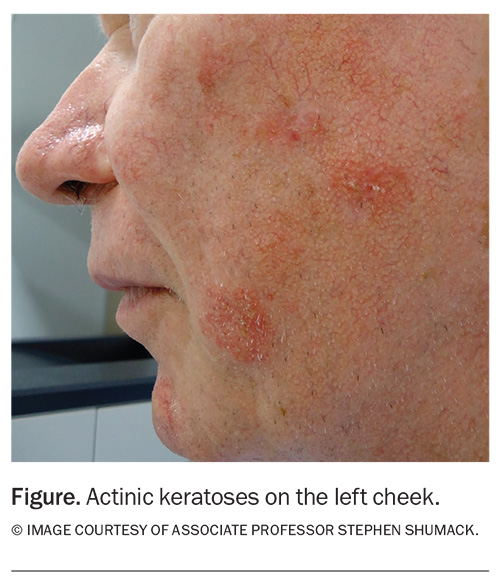
AKs are cutaneous lesions resulting from the proliferation of atypical keratinocytes.1 They are the mildest form of the keratinocyte atypia spectrum, with squamous cell carcinoma (SCC) being the most advanced. Although it is rare for a single AK to progress to an SCC, most SCCs arise from AKs.2 Risk factors for AKs include age, sun exposure, lower skin phototypes, immunosuppression and prior skin cancer.1 AKs are common in Australia, with a reported prevalence of over 40% in a sample of Queensland adults.3 Typically, they present as scaly, erythematous macules or papules, often with a ‘sandpaper’ texture on palpation (Figure).1 Multiple clinical variants exist, including hypertrophic and pigmented AKs. They may be present as distinct lesions or grouped with diffuse change affecting surrounding skin, referred to as field cancerisation. Although most AKs can be diagnosed clinically, the presence of suspicious features such as tenderness, bleeding and rapid growth may require a biopsy to exclude SCC.
Current management options
Treatment of AKs is typically guided by skin cancer risk and patient preference. Some patients prefer observation, given that one in three AKs may regress spontaneously.4 Alternatively, other patients prefer active treatment for symptomatic and cosmetic benefits and potential skin cancer prevention.
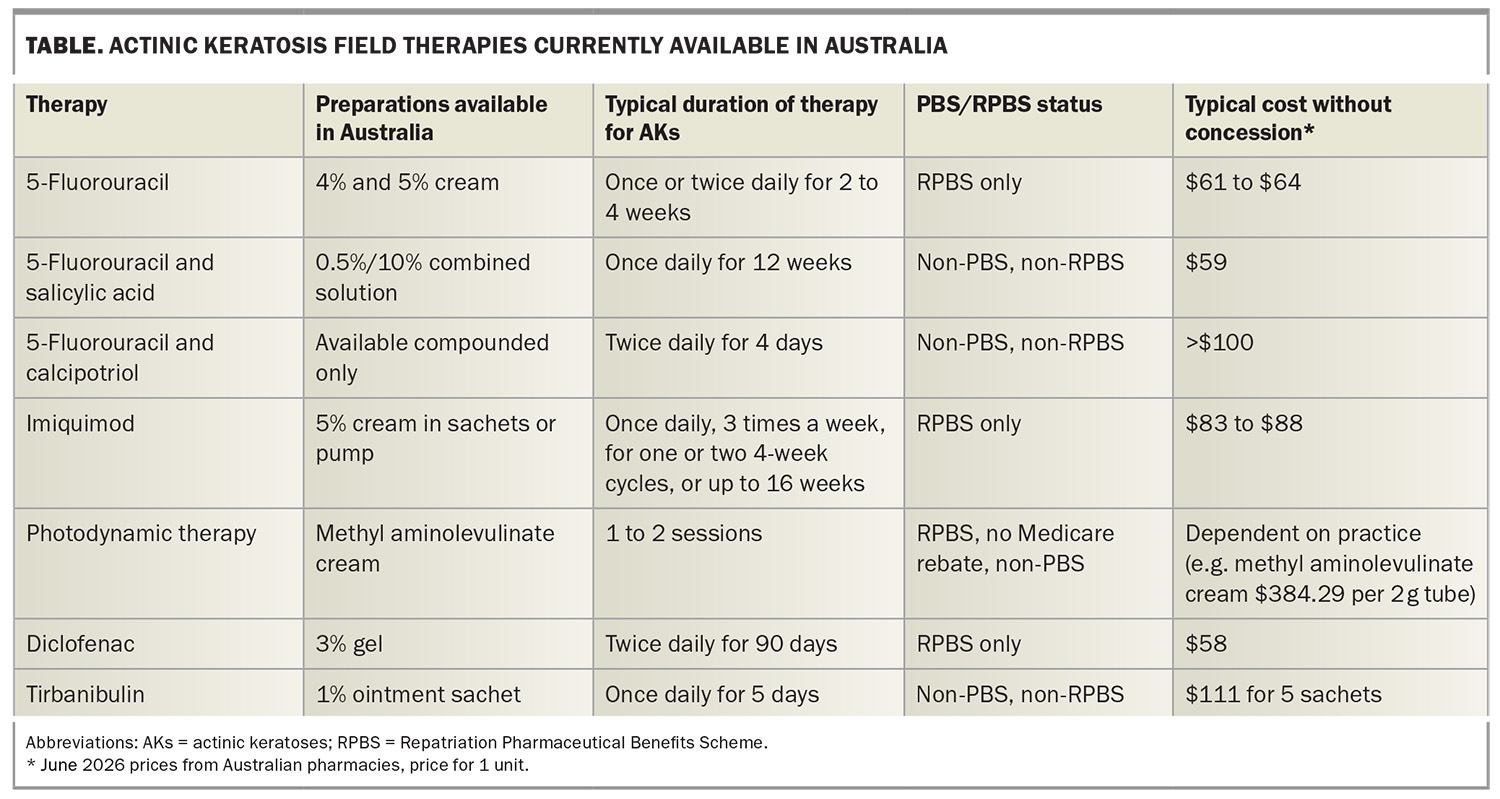
Treatment options for AKs may be divided into lesion-directed therapy (e.g. cryotherapy) or field therapy. Field therapy may be used for areas with a high density of discrete AKs (field cancerisation). Common field treatment options available in Australia are summarised in the Table.
Tirbanibulin
Mechanism of action and history
Tirbanibulin 1% ointment is a recently approved field therapy for AKs, typically prescribed as a five-day regimen of once daily topical application. Tirbanibulin inhibits microtubules and blocks Src tyrosine kinase signalling, leading to antiproliferative and pro-apoptotic effects.5 It was first approved for the treatment of AKs on the face and scalp in the USA in 2020, then in Europe in 2021.6 In Australia, tirbanibulin was initially approved by the TGA in September 2023 but only became commercially available in May 2026.
Efficacy
Tirbanibulin was assessed in two double-blind randomised phase 3 clinical trials in 2021, showing a significant therapeutic response compared with placebo.7 In the pooled analysis of 702 patients, 49% of patients treated with tirbanibulin experienced complete clearance, and 72% showed at least a 75% reduction in AK numbers in the treatment area: 83% lesion reduction in trial 1 and 100% lesion reduction in trial 2. The response rate on the face was higher than on the scalp. Compliance was excellent, with 99.7% of patients completing the treatment course. At one year, within the field of treatment, 73% of patients had recurrent or new lesions.
Tirbanibulin has also been examined in several real-world studies, with similar findings to the clinical trials. A 290-patient multicentre prospective observational study found 74% of patients achieved at least 75% clearance, with 75% satisfied with the treatment.8
Like other field therapies, in addition to treating AKs, tirbanibulin may also have cosmetic benefits. Reported effects include lightening of solar lentigines, improvement in skin texture and an overall antiageing effect on the area of treated skin.9
Adverse effects
As with other AK field treatments, tirbanibulin is associated with a local inflammatory skin response. The pivotal trials showed that the adverse event severity and incidence were similar to placebo in both trials.7 Local skin reactions were mostly mild to moderate (presumably due to the mode of action that does not induce pro-inflammatory cytokines, especially tumour necrosis factor) and transient, resolving without intervention.5 The reactions generally involve mild erythema and flaking, peaking about on day eight after the start of treatment (i.e. three days after completion of the five-day course), and resolving over an average of two to three weeks.6 Severe local reactions such as erosions and ulcerations may occur rarely. In phase 3 clinical trials, no serious adverse events related to tirbanibulin occurred.7
Comparison with other therapies
Although direct comparisons are limited, tirbanibulin appears to have similar efficacy to other field treatments, but possibly improved tolerability. A small, randomised trial comparing 5-fluorouracil, tirbanibulin and photodynamic therapy did not find a significant difference in efficacy, although it was not powered for noninferiority.10 However, tirbanibulin had a significantly lower local site reaction score than photodynamic therapy or 5-fluorouracil treatments. A 2022 systematic review of randomised control trials reported tirbanibulin as being superior in efficacy to diclofenac and similar in efficacy to 5-fluorouracil, imiquimod, photodynamic therapy and cryotherapy.11 Tirbanibulin has also shown favourable patient-reported outcomes, with one study noting 77% of patients felt it had less severe reactions than previous therapies and 72% describing greater overall satisfaction compared with their previous field therapies.8 The recurrence rates reported in the phase 3 clinical trials sit within the range reported with other AK treatments, which have recurrence rates ranging from 39% to 85% dependent on therapy type.12
Practical guidance for GPs
Indications for tirbanibulin
Tirbanibulin is approved by the TGA for the topical field treatment of nonhyperkeratotic, nonhypertrophic AK of the face or scalp in adults.13 An observational study evaluating tirbanibulin outside of these indications reported comparable response rates for hyperkeratotic lesions (87.5%) and lesions on the trunk and limbs (87.5%) relative to the TGA-approved indications (89.2%).14
Prescribing tirbanibulin
Tirbanibulin is available as sachets, each containing 250 mg 1% tirbanibulin ointment, with one sachet used daily over a standard treatment course of five days. Each sachet is intended to cover an area of 25 cm2; however, overseas reports also note that some dermatologists have recommended that larger treatment areas are possible with one sachet.6 Up to four treatment cycles one to two months apart may be considered for more advanced disease.6
Education for patients
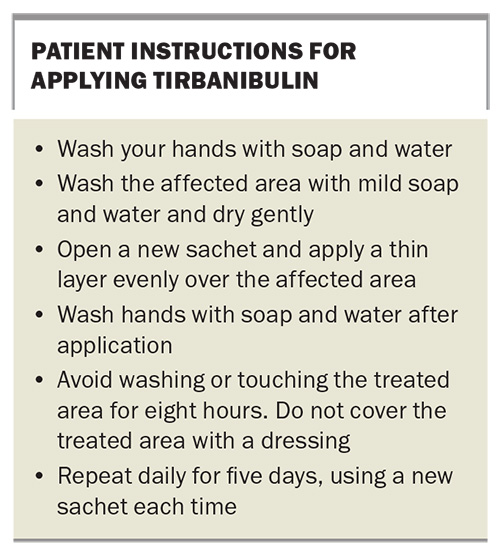
General patient instructions for applying tirbanibulin are summarised in the Box. As with other treatments for AKs, patients should be informed about the chronic nature of the condition and the potential need for repeat treatments.6 They should be made aware that local reactions are common and that these typically resolve without treatment. Additionally, patients should be advised to return for assessment if any lesion becomes enlarged, tender or prone to bleeding, as this may suggest progression to skin cancer.
Choosing between tirbanibulin and other field treatments
Although there is a lack of comparative trials, the efficacy of tirbanibulin appears similar to that of other AK therapies. As a result, the choice of tirbanibulin compared to other field therapies is generally dependent on patient factors. Tirbanibulin may be an ideal option for patients seeking the convenience of short-duration topical field therapy. In addition, the reportedly milder local application site reactions may be attractive to patients who have had severe local reactions to other therapies.
As with most topical field therapies for AKs, potential skin cancer preventive effects have not yet been studied with tirbanibulin. In addition, with the current approved TGA indication, tirbanibulin may not be ideal for large areas of AKs, as one sachet is only approved in Australia to cover a treatment field of 25 cm2. However, it has been used on areas as large as 100 cm2 and is approved for this field size in the USA, while the European Medicines Agency is currently reviewing data on larger treatment fields, with submission of the dossier to the TGA expected later this year.6 In contrast, other therapies such as 5-fluorouracil may be used for an area up to 500 cm2.
As with other field therapies for actinic damage or skin field cancerisation, tirbanibulin is unlikely to be listed on the PBS.
Conclusion
Tirbanibulin is a useful addition to the AK treatment armamentarium, complementing currently available topical therapies, including 5-fluorouracil, imiquimod, diclofenac and photodynamic therapy. It may be ideal for patients seeking therapy of shorter duration with potentially reduced local reactions compared with other field therapies. Future comparative studies will be essential to determine tirbanibulin’s overall utility. MT
COMPETING INTERESTS: Dr van Ammers and Associate Professor Shumack: None. Associate Professor Foley has received research grants or clinical trial investigator fees paid to institution from Galderma and Valeant/iNova; payment or honoraria from CSL and Galderma; has been on Advisory boards for Actor Pharmaceuticals, CSL, Galderma, iNova/Valeant, and Mayne Pharma; and has received drug samples provided free of charge for patient use from Aspen Pharmacare.
This article is for general information purposes only, and the full Product Information should be consulted before prescribing any of the mentioned medications.
References
1. Reinehr CPH, Bakos RM. Actinic keratoses: review of clinical, dermoscopic, and therapeutic aspects. An Bras Dermatol 2019; 94: 637-657.
2. Criscione VD, Weinstock MA, Naylor MF, et al. Actinic keratoses: natural history and risk of malignant transformation in the Veterans Affairs Topical Tretinoin Chemoprevention Trial. Cancer 2009; 115: 2523-2530.
3. Frost C, Green A, Williams G. The prevalence and determinants of solar keratoses at a subtropical latitude (Queensland, Australia). Br J Dermatol 1998; 139: 1033-1039.
4. Steeb T, Petzold A, Hornung A, Wessely A, Berking C, Heppt MV. Spontaneous regression rates of actinic keratosis: a systematic review and pooled analysis of randomized controlled trials. Sci Rep 2022; 12: 5884.
5. Gilaberte Y, Fernández-Figueras MT. Tirbanibulin: review of its novel mechanism of action and how it fits into the treatment of actinic keratosis. Actas Dermo-Sifiliográficas 2022; 113: 58-66.
6. Ardigò M, Argenziano G, Campione E, et al. Real-world efficacy of tirbanibulin in actinic keratosis treatment: expert consensus and clinical insights. Dermatol Pract Concept 2025; 15: 5921.
7. Blauvelt A, Kempers S, Lain E, et al. Phase 3 trials of tirbanibulin ointment for actinic keratosis. N Engl J Med 2021; 384: 512-520.
8. Schlesinger T, Kircik L, Lebwohl M, et al. Patient- and clinician-reported outcomes for tirbanibulin in actinic keratosis in clinical practice across the United States (PROAK). J Drugs Dermatol 2024; 23: 338-346.
9. Li Pomi F, d’Aloja A, Valguarnera D, Vaccaro M, Borgia F. Exploring anti-aging effects of topical treatments for actinic keratosis. Medicina (Mex) 2025; 61: 207.
10. Venturi F, Magnaterra E, Gualandi A, et al. Randomized comparative study of 5-fluorouracil 4%, tirbanibulin, and photodynamic therapy for relapsing actinic keratoses. Photodiagnosis Photodyn Ther 2026; 58: 105359.
11. Heppt MV, Dykukha I, Graziadio S, Salido-Vallejo R, Chapman-Rounds M, Edwards M. Comparative efficacy and safety of tirbanibulin for actinic keratosis of the face and scalp in Europe: a systematic review and network meta-analysis of randomized controlled trials. J Clin Med 2022; 11: 1654.
12. Steeb T, Wessely A, Petzold A, et al. Long-term recurrence rates of actinic keratosis: a systematic review and pooled analysis of randomized controlled trials. J Am Acad Dermatol 2022; 86: 1116-1119.
13. Therapeutic Goods Administration. Australian Product Information. Klisyri (tirbanibulin) ointment. Available online at: https://www.ebs.tga.gov.au/ebs/picmi/picmirepository.nsf/pdf?OpenAgent&id=CP-2026-PI-01248-1&d=20260622172310101 (accessed June 2026).
14. Nazzaro G, Carugno A, Bortoluzzi P, et al. Efficacy and tolerability of tirbanibulin 1% ointment in the treatment of cancerization field: a real-life Italian multicenter observational study of 250 patients. Int J Dermatol 2024; 63: 1566-1574.
Single article purchases are temporarily unavailable due to site maintenance.
If you would like to purchase an article during this time, please email us at [email protected] with the article details and we'll assist you directly. We'll also let you know when online purchasing is available again.
Thank you for your patience and understanding.