
Device mastery: choosing inhalers and teaching techniques
Up to nine out of 10 patients with chronic obstructive pulmonary disease or asthma make at least one critical mistake when using their inhalers, undermining disease control and driving up healthcare demands.
- Correct inhaler technique is crucial for effective inhaled medication delivery.
- It is critically important to select an inhaler that the patient is able and willing to use.
- The most appropriate inhaler should be identified for each patient to ensure optimal care.
- All healthcare providers are responsible for regularly assessing inhaler technique and providing targeted education.
- Inhaler technique training and education are required when switching inhalers.
Poorly controlled asthma and chronic obstructive pulmonary disease (COPD) are a continuing challenge, and are linked to an increased risk of exacerbations, progressive decline in lung function and mortality.
The more poorly controlled day-to-day asthma is, the greater the risk of a severe asthma exacerbation. Nearly half (46%) of Australians with asthma have poorly controlled disease, with many underusing inhaled corticosteroid (ICS)-containing preventer inhalers and over-relying on short-acting beta-2 agonists (SABAs).1
COPD remains poorly managed in Australia, ranking as a leading cause of potentially preventable hospitalisations and the fifth most common cause of death.2,3 Progression to moderate and severe COPD and increased risk of exacerbation can be delayed with timely access to appropriate care.4
Inhaled therapy serves as the mainstay for treatment of asthma and COPD, as it facilitates efficient and targeted delivery of medication to the lungs, thereby minimising systemic exposure and reducing the risk of adverse effects. The increasing number of different devices allows for a person-centred approach; however, it also increases the complexity of choosing the right device for each patient.5
The 2025 Australian Asthma Handbook recently made significant changes to the diagnosis and treatment of asthma, championing the use of combination inhalers through anti-inflammatory reliever (AIR) and maintenance-and-reliever therapy (MART) regimens as initial treatment for adults and adolescents.6 ICS-containing inhalers are now recommended for both adults and children, with only a limited role for SABA-only therapy.6 Implementation of the new guidelines will drive changes in therapy and inhaler devices for many people.
This article discusses issues resulting in poor adherence to COPD and asthma inhaler therapy and errors in device technique that undermine disease control. Older age, cognitive impairment, multiple devices and lack of previous training are all risk factors for poor inhaler use and adherence.7
Adherence
Despite the availability of effective treatment, adherence to therapy remains poor among many people with asthma and COPD.8 Adherence rates in asthma and COPD have been shown to vary widely from 22% to 78%.9
Medication nonadherence with asthma and COPD therapy poses a significant burden for patients and the healthcare system. Nonadherence encompasses poor initiation, suboptimal implementation and nonpersistence of prescribed treatment.10 Nonadherence is associated with poor clinical outcomes, reduced health-related quality of life and a greater burden of disease.9,10
In patients with over 80% adherence, clinical outcomes improve significantly.11 Higher adherence is associated with fewer hospitalisations, exacerbations and emergency department visits, and with better lung function.11
Inhaler technique
An important contributing factor of nonadherence is poor inhalation technique.10 Poor adherence and technique with inhalers go hand-in-hand with poor clinical outcomes.10 Proper use of inhalers is of prime importance in optimising the management of asthma and COPD.
A global review noted that up to nine out of 10 patients with COPD or asthma were making at least one critical inhaler mistake, undermining disease control and driving up healthcare demands.10 Another review found that up to 94% of patients did not use their dry powder inhaler (DPI) device correctly, resulting in inadequate dosing, suboptimal disease control, worsening of quality of life and increased hospital admissions and mortality.12 Australian data suggest that only 10% of people with asthma can competently use their inhalers.13,14
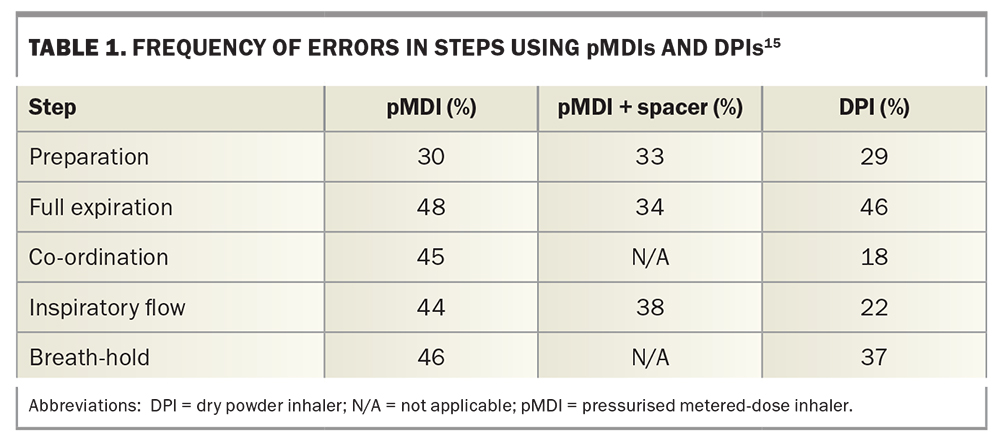
A systematic review conducted in 2016 assessed the persistent issues with inhaler technique over the previous 40 years in patients using MDIs and DPIs.15 Only 31% of patients demonstrated correct inhaler technique and 41% exhibited acceptable technique, whereas 31% had poor technique.15 Despite various educational initiatives and device improvements, error rates have not improved over time and remain high.15
The frequency of errors reported during the various steps in the use of pressurised metered dose inhalers (pMDIs) and DPIs are summarised in Table 1.15
It should be noted there is generally poor correlation between doctors’ estimates of patient adherence and objective data from electronic monitoring devices.16
The most common errors relate to breathing pattern rather than manipulation of the inhaler device, and such errors increase with age.17 The CRITical Inhaler mistaKes and Asthma control (CRITIKAL) study showed that about 35% and 47% of patients with asthma using a DPI or pMDI, respectively, had insufficient inspiratory flow.18
In a study of 150 children aged 7 to 17 years, only 13% of children prescribed a pMDI used their device appropriately with no errors.19 Children prescribed the DPIs Accuhaler or Turbuhaler had a higher rate of appropriate inhaler technique, at 28.9% and 38.5%, respectively.19
Advancements in digital health technologies are shaping the future of respiratory medicine. Smart or digital inhalers are becoming significant instruments designed to address issues related to medication adherence and proper inhaler usage.10 Smart inhalers are equipped with sensors that monitor medication usage, timing and technique, sharing data with smartphone apps. However, they are not in everyday use in Australia, so a patient-centred approach to improving inhaler adherence and technique is needed.
Inhaler device types, their correct use and common errors
A comprehensive understanding of the different types of inhalers and the steps for correct use is needed to avoid critical errors.
Inhaler devices can be grouped into three main types:
- pMDIs
- DPIs
- soft mist inhalers (SMIs).
Different devices vary in terms of preparation steps, the level of manual skill and strength needed to load or operate them, necessary inspiratory flow rate, cleaning and maintenance needs and their carbon footprint.20
Pressurised metered-dose inhalers
Since their introduction in 1956, pMDIs have been the dominant inhaler for treating asthma and COPD. About 80% of the roughly 25 million inhalers dispensed in Australia each year are pMDIs, with about 15 million being SABA inhalers.21
pMDIs require slow, deep inhalation over 3 to 5 seconds, co-ordinated with actuation. It is essential for the dose to be released at the same time or very soon after the patient starts inhaling – not before.22
Common errors with pMDIs include activating the device before inhaling and not properly preparing the second dose.18
Spacers can help by making it easier to co-ordinate inhalation with actuation. Additionally, spacers decrease the velocity of the aerosol and help vapourise particles to an optimal size, which lessens deposition in the oropharynx and boosts delivery to the lungs.23 A single slow and deep inhalation followed by a breath-hold of 10 seconds is the best technique for spacer use with pMDIs.24 If a patient is unable to take a slow, deep breath, tidal breathing with three or four normal breaths may be used.
Dry powder inhalers
Up to 94% of DPI users with asthma or COPD make at least one inhaler error during each inhalation that results in suboptimal treatment.12
Correct use of DPIs depends on the patient’s inspiratory effort and the device’s internal resistance to effectively aerosolise the medication. DPIs require users to inhale ‘quickly and deeply’ to generate appropriate inspiratory flow to activate the device.
Most adults and older children can generate the required inspiratory flow rates to use DPIs, even during exacerbations.25 A recent systematic review concluded that most primary school-age children with stable asthma can use a DPI with adequate training, support and practice.26 Regular checks and targeted education are needed to sustain correct technique.26
DPIs provide several advantages, including breath-actuated delivery that eliminates the need for co-ordination between inhalation and actuation.5 They do not require a spacer, feature a dose-count indicator and contain no propellants, resulting in a significantly lower carbon footprint compared with pMDIs.5
DPIs face some challenges. Particles sized between 1 and 5 micrometres are needed to reach deep into the lungs, but these tiny particles tend to stick together because of their large surface area-to-volume ratio and strong interparticle forces.10 As a result, dry powders often clump, flow poorly and do not aerosolise well.10 Patients must inhale forcefully to properly disperse the medication and to minimise deposition in the mouth and throat.10
Environmental factors, including relative humidity and temperature, can impact powder dispersibility.27
Soft mist inhalers
SMIs (i.e. Respimat) are designed to enhance drug delivery to the lungs, reduce the need for patient co-ordination between actuation and inhalation, minimise inspiratory effort and improve patients’ experience and ease of use.28 Lung deposition is high and oropharyngeal deposition is low with SMIs.28
SMIs can be used in patients with lower inspiratory flow rates.29 They still require a degree of hand–breath co-ordination and breath-holding. Their relatively long duration of spray requires a slow inhalation.
Common errors with the Respimat SMIs are not holding the device upright and turning the base until it clicks; not taking a slow, steady and deep inhalation; and not breath-holding after inhalation.30
Device selection
Choosing an inhaler device should be tailored to each patient. Evaluating factors such as a patient’s inspiratory flow, development stage, dexterity, co-ordination and personal preferences can help determine which device he or she is most likely to use correctly and consistently (Table 2).
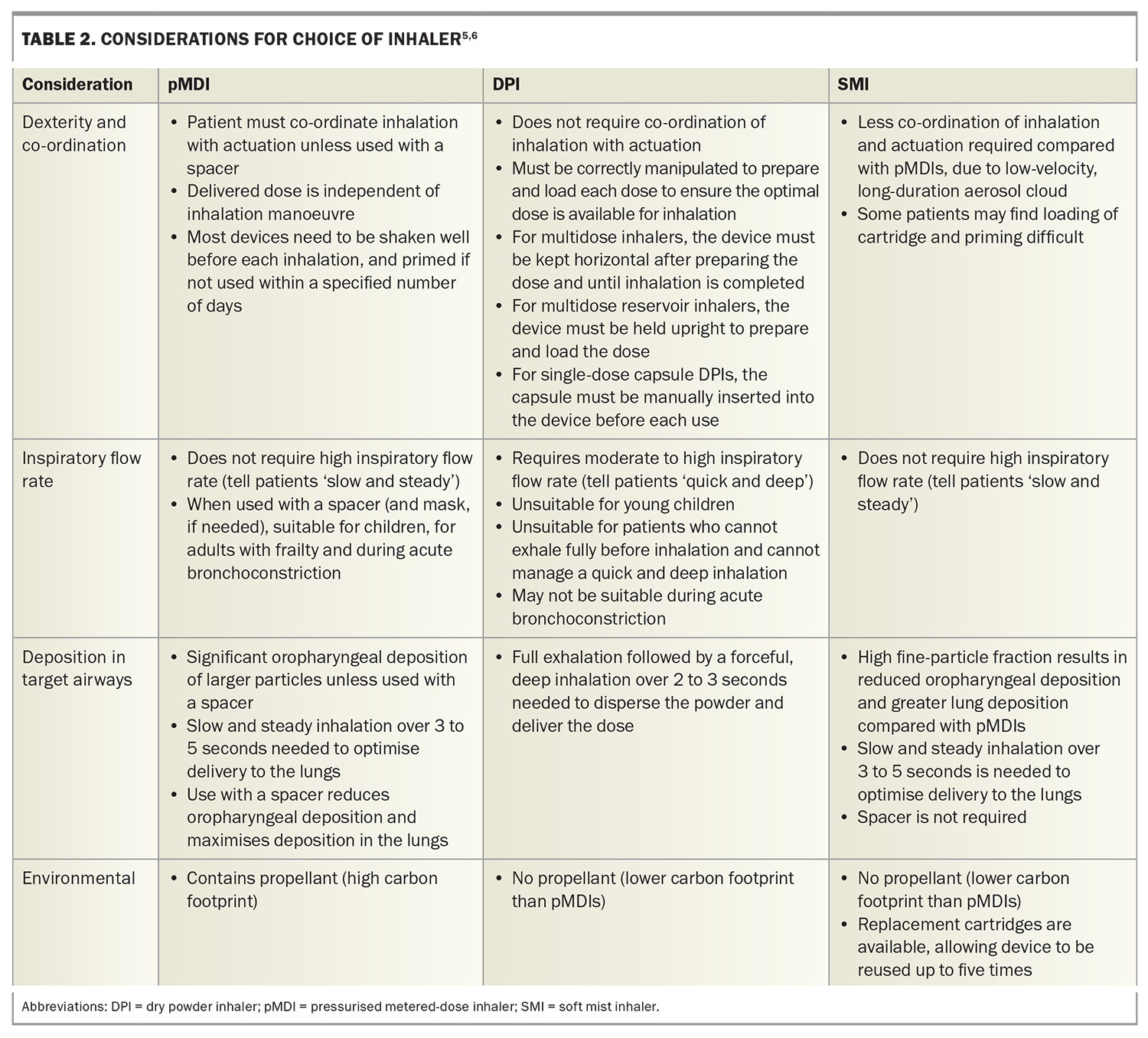
The choice of inhaler should be made with the individual patient, including an assessment of technique, rather than making assumptions about what can or cannot be mastered.31
DPIs and pMDIs with a spacer have equivalent clinical effectiveness in adults and children.31 However, the very young, very old and very ill may not be able to use DPIs effectively.17
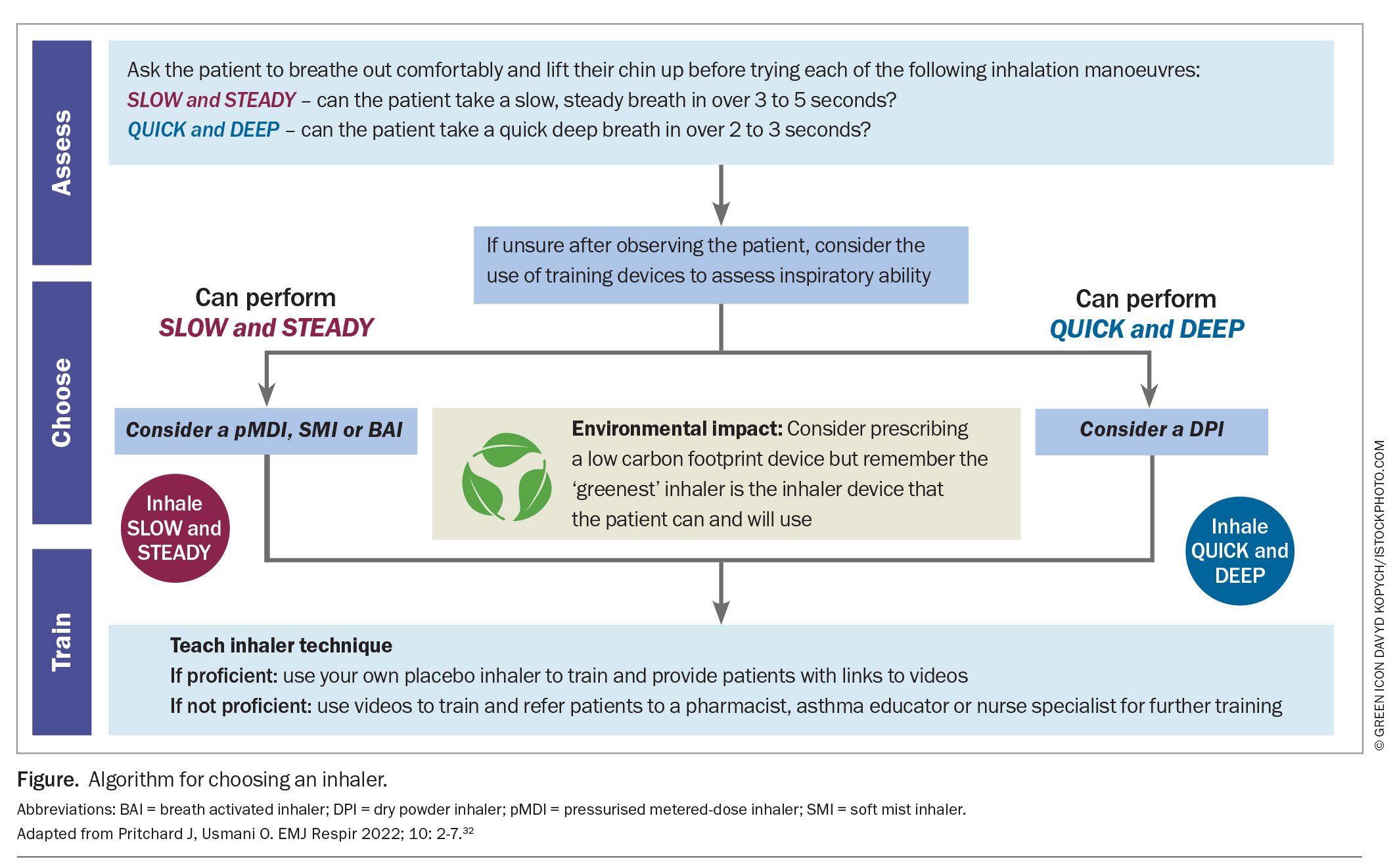
Determining a patient’s inspiratory flow can help with choosing an inhaler device (Figure).32 When a patient is using a DPI, observe for cheek depression during a strong, deep inhalation. In contrast, for patients using pMDIs there should be no cheek depression as they need a gentle and slow inhalation lasting 3 to 5 seconds. To confirm proper DPI technique, look for the diaphragm rising, mild depression of the intercostal muscles and tightening of the scalene muscles. These signs indicate that inspiratory flow is sufficient to disperse the powder effectively, reduce oropharyngeal deposition and enhance lung deposition.33
For patients needing multiple inhaled medications, the use of dual and triple combination inhalers and minimising the variety of inhaler types may decrease technique-related errors and improve adherence to prescribed therapy.34
Studies indicate that prescribing inhaler devices using similar inhalation techniques is associated with better patient outcomes compared with prescribing a range of devices needing different techniques.35
Environmental impact
Prescribing of pMDIs represents a key carbon hotspot for healthcare. Reducing emissions from respiratory inhalers is a priority area of Australia’s National Health and Climate Strategy, due to their significant greenhouse gas impact.36
Currently available pMDIs contain hydrofluorocarbon propellants (HFA134a and HFA227), which have carbon footprints many times higher than that of carbon dioxide.17 DPIs do not contain propellants and have a carbon footprint up to 20 times smaller than that of pMDIs.37
Global transition to low-Global Warming Potential (GWP) propellants in pMDIs is underway, driven by international environmental regulations. Switching to low-GWP propellants can reduce the carbon footprint of inhalers by up to 89%.38
However, the focus should be on improving asthma care and reducing the need for SABA-only reliever therapy with ICS-formoterol AIR and MART regimens. Well-controlled asthma has one-third of the carbon footprint of poorly controlled asthma due to higher pMDI SABA use and reduced healthcare utilisation related to asthma exacerbations.39 Increasing use of AIR and MART regimens should dramatically reduce the use of SABA inhalers, improving asthma outcomes and reducing the environmental footprint.21
Patient conversations
Involving patients in shared decision-making on the choice of their inhalers is a critical part of the conversation on optimising asthma and COPD control and reducing the risk of future exacerbations. Device switching has been shown to lead to poorer outcomes, with both environmental and economic consequences, so these decisions must be accompanied by adequate patient education and inhaler training.17 All switching of treatment and inhalers should be made through shared decision-making and agreed with the patient.17 Inhaler technique guidance should be provided alongside any switch: every patient must be shown how to use her or his new inhaler.40
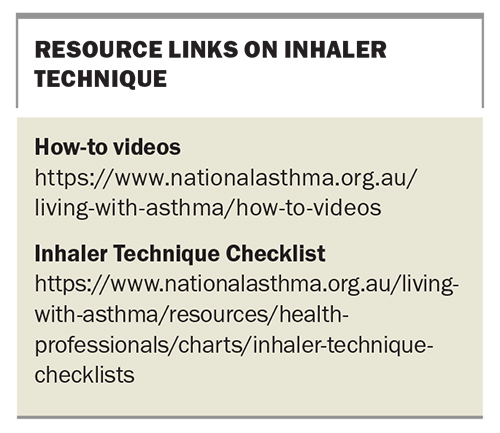
Resources to support patient conversations and education include verbal and physical demonstration, videos demonstrating correct technique, checklists for assessment and placebo devices (Box). Australian randomised controlled trials have shown that adults with asthma are more likely to use their inhaler correctly after a health professional demonstrated the correct technique using a placebo inhaler, as well as explaining and providing written instructions, than after receiving only written and verbal instructions or after written instructions only.6
The use of two or more different types of inhalers (inhaler-device polypharmacy) is a common problem and may lead to inadequate inhaler technique. Inhaler-device polypharmacy can be minimised by use of single-inhaler dual and triple therapy.5 Only one or two inhalers should be needed in asthma management,41 especially with the shift to AIR therapy recommended in the Australian Asthma Handbook.6
Referring patients for a Home Medicines Review builds a multidisciplinary approach to care. Credentialled pharmacists can reinforce key messages and have the time to explore the patient’s knowledge, experiences, values, beliefs, attitudes and goals, and tailor support for self-management accordingly. Pharmacists can provide an in-depth review of inhaler technique and adherence, as well as provide patient education.42
Conclusion
Choosing an inhaler device that a patient can use properly is essential for effective management of asthma and COPD, as well as for minimising environmental impact. To select the most suitable inhaler, it is important to understand the differences among devices and consider what makes each appropriate for individual patients. Inhaler technique should be checked and improved whenever possible. Taking a multidisciplinary approach can help achieve the best results. MT
COMPETING INTERESTS. Clinical Associate Professor Rigby is the Clinical Executive Lead, National Asthma Council Australia, and is on the COPD Advisory Committee and Primary Care Advisory Committee, Lung Foundation Australia; and reports honoraria for presentations, conference registration, travel and advisory groups from AstraZeneca, Care Pharmaceuticals, Chiesi, Boehringer Ingelheim, GSK, Menarini, Teva and Trudell.
References
1. Reddel HK, Sawyer SM, Everett PW, et al. Asthma control in Australia: a cross-sectional web-based survey in a nationally representative population. Med J Aust 2015; 202: 492-496.
2. Australian Institute of Health and Welfare. Potentially preventable hospitalisations in Australia by small geographic areas, 2020–21 to 2021–22. Canberra: AIHW; 2024.
3. Australian Institute of Health and Welfare. Deaths in Australia. Canberra: AIHW; 2025.
4. Evohealth. Change that can’t wait: Reducing the human and economic burden of COPD in Australia. Canberra: Evohealth, Canberra, 2025
5. Rigby D. Inhaler device selection for people with asthma or chronic obstructive pulmonary disease. Aust Prescr 2024; 47: 140-147.
6. National Asthma Council Australia. Australian Asthma Handbook, The National Guidelines for Health Professionals. (Version 3.0). Melbourne: National Asthma Council Australia; 2025. Available online at: https://www.asthmahandbook.org.au/ (accessed April 2026).
7. Usmani OS, Lavorini F, Marshall J, et al. Critical inhaler errors in asthma and COPD: a systematic review of impact on health outcomes. Respir Res 2018; 19: 10.
8. Murillo ER, Mora JR, Bachiller MM, et al. Factors associated with low adherence to inhaled therapy in patients with chronic respiratory diseases: a cross-sectional study. BMC Pulm Med 2025; 25: 94.
9. Mäkelä MJ, Backer V, Hedegaard M, et al. Adherence to inhaled therapies, health outcomes and costs in patients with asthma and COPD. Respir Med 2013; 107: 1481-1490.
10. Jansen EM, van de Hei SJ, Dierick BJH, et al. Global burden of medication non-adherence in chronic obstructive pulmonary disease (COPD) and asthma: a narrative review of the clinical and economic case for smart inhalers. J Thorac Dis 2012; 13: 3846-3864.
11. van Boven JF, Chavannes NH, van der Molen T, et al. Clinical and economic impact of non-adherence in COPD: a systematic review. Respir Med 2014; 108: 103-13.
12. Lavorini F, Magnan A, Dubus JC, et al. Effect of incorrect use of dry powder inhalers on management of patients with asthma and COPD. Respir Med 2008; 102: 593-604.
13. Bosnic-Anticevich SZ, Sinha H, So S, Reddel HK. Metered-dose inhaler technique: the effect of two educational interventions delivered in community pharmacy over time. J Asthma 2010; 47: 251-256.
14. Saini B, LeMay K, Emmerton L, et al. Asthma disease management-Australian pharmacists’ interventions improve patients’ asthma knowledge and this is sustained. Patient Educ Couns 2011; 83: 295-302.
15. Sanchis J, Gich I, Pedersen S, Aerosol Drug Management Improvement Team (ADMIT). Systematic review of errors in inhaler use: has patient technique improved over time? Chest 2016; 150: 394-406.
16. Burgess SW, Sly PD, Morawska A, Devadason SG. Assessing adherence and factors associated with adherence in young children with asthma. Respirology 2008; 13: 559-563.
17. Pritchard JN. The climate is changing for metered-dose inhalers and action is needed. Drug Des Devel Ther 2020; 14: 3043-3055.
18. Price DB, Román-Rodríguez M, McQueen RB, et al. Inhaler errors in the CRITIKAL study: type, frequency, and association with asthma outcomes. J Allergy Clin Immunol Pract 2017; 5: 1071-1081.e9.
19. Almomani BA, Al‐Qawasmeh BS, Al‐Shatnawi SF, et al. Predictors of proper inhaler technique and asthma control in pediatric patients with asthma. Pediatr Pulmonol 2021; 56: 866-874.
20. Halpin DMG, Mahler DA. A systematic review of published algorithms for selecting an inhaled delivery system in chronic obstructive pulmonary disease. Ann Am Thorac Soc 2022; 19: 1213-1220.
21. Forrester M, Needham C, Allender S, et al. The National Sustainable Asthma Care Roadmap – Roundtable Report. Melbourne: Asthma Australia; 2024.
22. The Inhaler Error Steering Committee; Price D, Bosnic-Anticevich S, Briggs A, et al. Inhaler competence in asthma: common errors, barriers to use and recommended solutions. Respir Med 2013; 107: 37-46.
23. Levy ML, Dekhuijzen PN, Barnes PJ, et al. Inhaler technique: facts and fantasies. A view from the Aerosol Drug Management Improvement Team (ADMIT). NPJ Prim Care Respir Med 2016; 26: 16017.
24. Vincken W, Levy ML, Scullion J, et al. Spacer devices for inhaled therapy: why use them, and how? ERJ Open Res 2018; 4: 00065-2018.
25. Vartiainen VA, Lavorini F, Murphy AC, Rabe KF. High inhaler resistance does not limit successful inspiratory maneuver among patients with asthma or COPD. Expert Opin Drug Deliv 2023; 20: 385-393.
26. Kuek SL, Wong NX, Dalziel S, et al. Dry-powder inhaler use in primary school-aged children with asthma: a systematic review. ERJ Open Res 2024; 10: 00455-2024.
27. Lu X, Chen L, Wu C, et al. The effects of relative humidity on the flowability and dispersion performance of lactose mixtures. Materials (Basel) 2017; 10: 592.
28. Iwanaga T, Tohda Y, Nakamura S, Suga Y. The Respimat® Soft Mist Inhaler: implications of drug delivery characteristics for patients. Clin Drug Investig 2019; 39: 1021-1030.
29. García-Río F, Soler-Cataluña JJ, Alcazar B, et al. Requirements, strengths and weaknesses of inhaler devices for COPD patients from the expert prescribers’ point of view: results of the EPOCA Delphi Consensus. COPD 2017; 14: 573-580.
30. Navaie M, Dembek C, Cho-Reyes S, et al. Device use errors with soft mist inhalers: a global systematic literature review and meta-analysis. Chron Respir Dis 2020; 17: 1479973119901234.
31. Twohig H, Franklin L, Carroll W, et al. A systematic review of the clinical effectiveness of dry powder inhalers in maintenance treatment and in treatment of acute exacerbations of asthma in children. Paediatr Respir Rev 2025; S1526-0542(25)00036-3.
32. Pritchard J, Usmani O. The greenest inhaler: a patient-centric approach. EMJ Respir 2022; 10: 2-7.
33. Usmani O. Personalising the inhaler device to the patient. Sydney: Healthed; 2025. Available at https://www.healthed.com.au/videos/personalising-the-inhaler-device-to the-patient (accessed April 2026).
34. Usmani OS, Hickey AJ, Guranlioglu D, et al. The impact of inhaler device regimen in patients with asthma or COPD. J Allergy Clin Immunol Pract 2021; 9: 3033-3040.e1.
35. Bosnic-Anticevich S, Chrystyn H, Costello RW, et al. The use of multiple respiratory inhalers requiring different inhalation techniques has an adverse effect on COPD outcomes. Int J Chron Obstruct Pulmon Dis 2017; 12: 59-71.
36. Australian Government Department of Health and Aged Care. National Health and Climate Strategy. Canberra: Commonwealth of Australia; 2023. Available online at: https://www.cdc.gov.au/resources/publications/national-health-and-climate-strategy (accessed April 2026).
37. Fulford B, Mezzi K, Aumônier S, et al. Carbon footprints and life cycle assessments of inhalers: a review of published evidence. Sustainability 2022; 14: 7106.
38. Pernigotti D, Stonham C, Panigone S, et al. Reducing carbon footprint of inhalers: analysis of climate and clinical implications of different scenarios in five European countries. BMJ Open Respir Res. 2021; 8: 1-11.
39. Wilkinson A, Maslova E, Janson C, et al. Greenhouse gas emissions associated with asthma care in the UK: results from SABINA CARBON. Eur Respir J 2021; 58 (suppl 65): OA76.
40. Asthma+Lung UK. NG245 One year on: implementing the BTS/NICE/SIGN asthma guideline. London: Asthma + Lung UK; 2026. Available online at: https://www.asthmaandlung.org.uk/ng245-one-year (accessed April 2026).
41. McDonald VM, Gibson PG. Inhalation-device polypharmacy in asthma. Med J Aust 2008; 182: 250-251.
42. Rigby D. Asthma conversations. Aust J Pharm 2021; 102: 81-85.
Single article purchases are temporarily unavailable due to site maintenance.
If you would like to purchase an article during this time, please email us at [email protected] with the article details and we'll assist you directly. We'll also let you know when online purchasing is available again.
Thank you for your patience and understanding.