
The ADAPT peanut oral immunotherapy program

Dr Brettig is the ADAPT Medical Lead and a Postdoctoral Fellow at the National Allergy Centre of Excellence (NACE); and a Paediatric Allergist Immunologist at the Population Allergy Group at Murdoch Children’s Research Institute (MCRI), Melbourne.
Professor Perrett is the ADAPT Program Lead and Director of NACE; Group Leader of the Population Allergy Research Group at MCRI, Melbourne; Paediatric Allergist and Vaccinologist at the Department of Allergy and Immunology, The Royal Children’s Hospital, Melbourne; and an Honorary Professorial Fellow at the Department of Paediatrics, the University of Melbourne, Melbourne, Vic.
Food Allergy
Infant and newborn nutrition

The Allergy Development to an Accelerated Pathway to Tolerance (ADAPT) peanut oral immunotherapy program is the world’s first nationally standardised model of care for food allergy treatment delivered in public healthcare. Using an improvement science framework, it aims to provide equitable, evidence-based care for eligible infants.
- Peanut allergy affects about 3% of school-aged children in Australia and resolves spontaneously in only a minority, making it a good target for early intervention.
- Oral immunotherapy involves daily doses of a food allergen that are gradually increased to raise the threshold at which a reaction occurs (i.e. desensitisation), with the ideal goal of inducing remission (i.e. ongoing tolerance without relying on ongoing regular daily dosing) after treatment cessation.
- The Allergy Development to an Accelerated Pathway to Tolerance (ADAPT) program is the world’s first nationally standardised model of care for food allergy treatment, delivered through 10 paediatric hospitals across five Australian states.
- Families must be counselled about the outcomes of oral immunotherapy, treatment burden, the risk of allergic reactions (including anaphylaxis) during treatment and the importance of daily dosing and carrying an adrenaline autoinjector.
Food allergy is a significant health issue in Australia, with about one in 10 infants developing a food allergy by the age of 1 year.1 Peanut allergy is the most frequently encountered immunoglobulin (Ig)E-mediated food allergy in Australian school-aged children and, unlike many childhood food allergies, such as cow’s milk and egg allergies, is less likely to resolve on its own. Peanut allergy affects about 3% of school-aged children in Australia, and up to 30% will outgrow it, meaning the majority face a lifetime of strict allergen avoidance, along with anxiety, dietary restriction and the risk of anaphylaxis.1,2
For decades, the cornerstone of management for IgE-mediated food allergy has been strict avoidance of the identified allergen, combined with patient education, provision of an adrenaline autoinjector and an allergy management plan for at-risk individuals, and optimisation of coexisting atopic conditions, such as asthma and eczema. Allergen avoidance, however, is imperfect; accidental exposures occur, and families report significant anxiety and reduced quality of life as a result of living with food allergy.3
Oral immunotherapy (OIT) has emerged over the past two decades as a promising disease-modifying treatment for food allergy and has been shown to improve quality of life. OIT works by introducing and then gradually increasing a patient’s daily intake of a food allergen, typically starting with very small doses and escalating over months, until a maintenance dose is reached. This process raises the threshold at which an allergic reaction is triggered (a process known as desensitisation). When the treatment ends, some patients maintain nonreactivity even after a period of avoidance (usually weeks to months), a state known as remission, meaning they are not relying on a regular daily dose to maintain this tolerance. Clinical trials have demonstrated substantial efficacy benefits for peanut OIT, particularly when commenced in early childhood.4,5
Until July 2024, the Australasian Society of Clinical Immunology and Allergy (ASCIA) maintained that OIT was not yet ready to be offered as standard care outside clinical trials, citing ongoing needs for evidence on long-term safety, efficacy and quality-of-life outcomes. Consequently, some families sought OIT in private settings or even travelled overseas to access treatment. Following the commencement of the Allergy Development to an Accelerated Pathway to Tolerance (ADAPT) program in 2024, and again in 2026, ASCIA revised its position statement to support the use of OIT in clinical care for selected patients who may benefit from treatment. This support is contingent on OIT being delivered within a consistent, evidence-based protocol under specialist supervision and regular peer review.6
This article describes the ADAPT OIT program, the world’s first nationally standardised model of care for food allergy treatment.7 The program was launched in July 2024 across 10 paediatric hospitals in five Australian states and offers eligible infants a structured, equitable pathway towards peanut tolerance through the Australian public hospital system.
Why peanut? Why early?
The ADAPT program focuses specifically on peanut OIT in infants for several reasons.
- Peanut is the most common trigger of community-based anaphylactic reactions in both young children and adolescents in Australia and carries a disproportionately low rate of natural resolution compared with other childhood food allergies.8
- Peanut is also the most extensively studied food allergen in OIT clinical trials, and meta-analyses suggest that peanut OIT is the most effective of any food allergen studied at achieving desensitisation.9
- Evidence strongly suggests that OIT is more effective when commenced in early life. The Oral Immunotherapy for Induction of Tolerance and Desensitization in Peanut-Allergic Children (IMPACT) trial, conducted in children aged 1 to 3 years, found that 71% of participants who started OIT before 24 months of age achieved remission (defined as tolerating 5000 mg of peanut protein after a six-month avoidance period, compared with 19% of those who started between 36 and 48 months of age).5 The Peanut Oral Immunotherapy Study of Early Intervention for Desensitization (POSEIDON) trial, with children aged 1 to 4 years of age, similarly demonstrated higher desensitisation rates compared with the Peanut ALlergy Oral Immunotherapy Study of AR101 for DEsensitization (PALISADE) trial, involving children aged 4 to 17 years of age (68.4% vs 50.3%).10,11 This suggests there is a window of opportunity in early infancy during which immune tolerance may be more readily achieved.
The ADAPT program targets infants in whom peanut allergy is diagnosed at or before 12 months of age, with eligibility to commence OIT before 18 months of age. This reflects a pragmatic balance between maximising potential treatment benefit, allowing sufficient time for eligible infants to be enrolled after diagnosis and fitting within the resource constraints of the participating hospitals.
What is the ADAPT OIT program?
The ADAPT program was developed through an extensive collaborative process, beginning in September 2023 and co-ordinated by the National Allergy Centre of Excellence (NACE), Australia’s peak allergy research body, established following the 2020 Parliamentary Inquiry into Allergies and Anaphylaxis. NACE aims to transform consumer-centred allergy care by building critical national research infrastructure, clinical innovation and collaboration. The objective of the ADAPT program is to provide a pragmatic, standardised OIT program for the treatment of IgE-mediated food allergies embedded in clinical care within a health learning system framework for real-time systematic evaluation and program optimisation.
Consultation for the program design involved paediatric allergy specialists and immunologists from 10 paediatric hospitals, international OIT experts and significant consumer input through the NACE Consumer Advisory Group and Australia’s peak consumer body, Allergy & Anaphylaxis Australia. The result is a pragmatic, evidence-based and equitable program that can be delivered within existing public hospital infrastructure. NACE provides the program framework and evaluates the program’s performance but does not fund the individual site delivery. Implementing a new program without additional service delivery funding means that capacity will vary between sites, depending on existing hospital resources.
The ADAPT OIT evaluation study runs alongside the ADAPT program to evaluate its implementation as a new model of care in Australia. This rigorous, improvement science approach allows the program to be continuously refined based on real-world evidence. The results of the ADAPT OIT evaluation study will be published in peer-reviewed journals and presented at international scientific meetings.
Who is eligible?
The ADAPT program may be considered for infants who meet the following criteria at the time of their first allergy appointment (at one of 10 participating hospitals across Adelaide, Brisbane, Melbourne, Newcastle, Perth and Sydney):
- a clinical history consistent with an IgE-mediated allergic reaction to peanut, diagnosed at or before 12 months of age
- evidence of peanut sensitisation, defined as either a positive peanut skin-prick test (≥3 mm) or a positive peanut-specific IgE or Arachis hypogaea 2-specific IgE (≥0.35 kUA/L)
- ability to participate in the program requirements
- family’s competence to recognise and manage an allergic reaction, including anaphylaxis
- family’s ability to prepare and administer doses at home and observe the child for the appropriate time periods
- family’s ability to attend appointment visits regularly.
The ADAPT program is not appropriate for infants with conditions that would increase the risks of OIT, including a history of severe anaphylaxis (requiring more than two doses of intramuscular adrenaline or an intravenous adrenaline infusion), significant cardiac or respiratory disease that would increase the risk of severe anaphylaxis, confirmed or suspected eosinophilic oesophagitis, current beta-blocker or ACE inhibitor use and concurrent systemic immunomodulatory treatment.
What does the program involve?
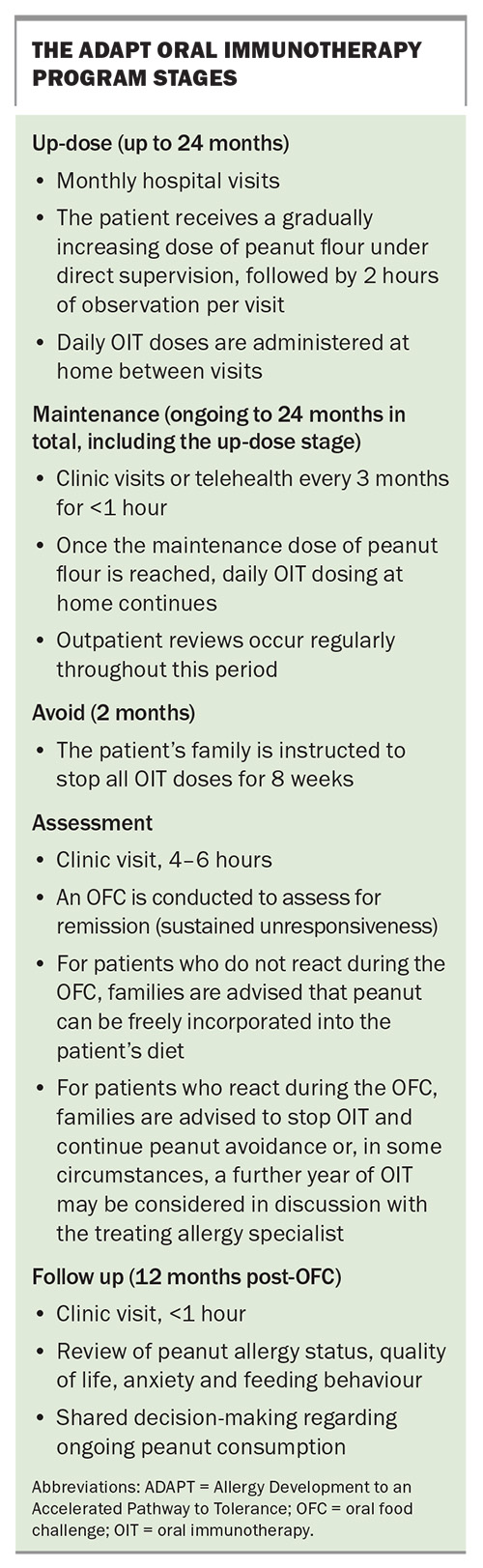
The ADAPT program uses supermarket-stocked peanut flour as the OIT product, which costs about $10 for three months of doses. All clinical visits are delivered through the public hospital system and are funded by Medicare. The program comprises five stages over a 38-month period (Figure). These stages are described in the Box.
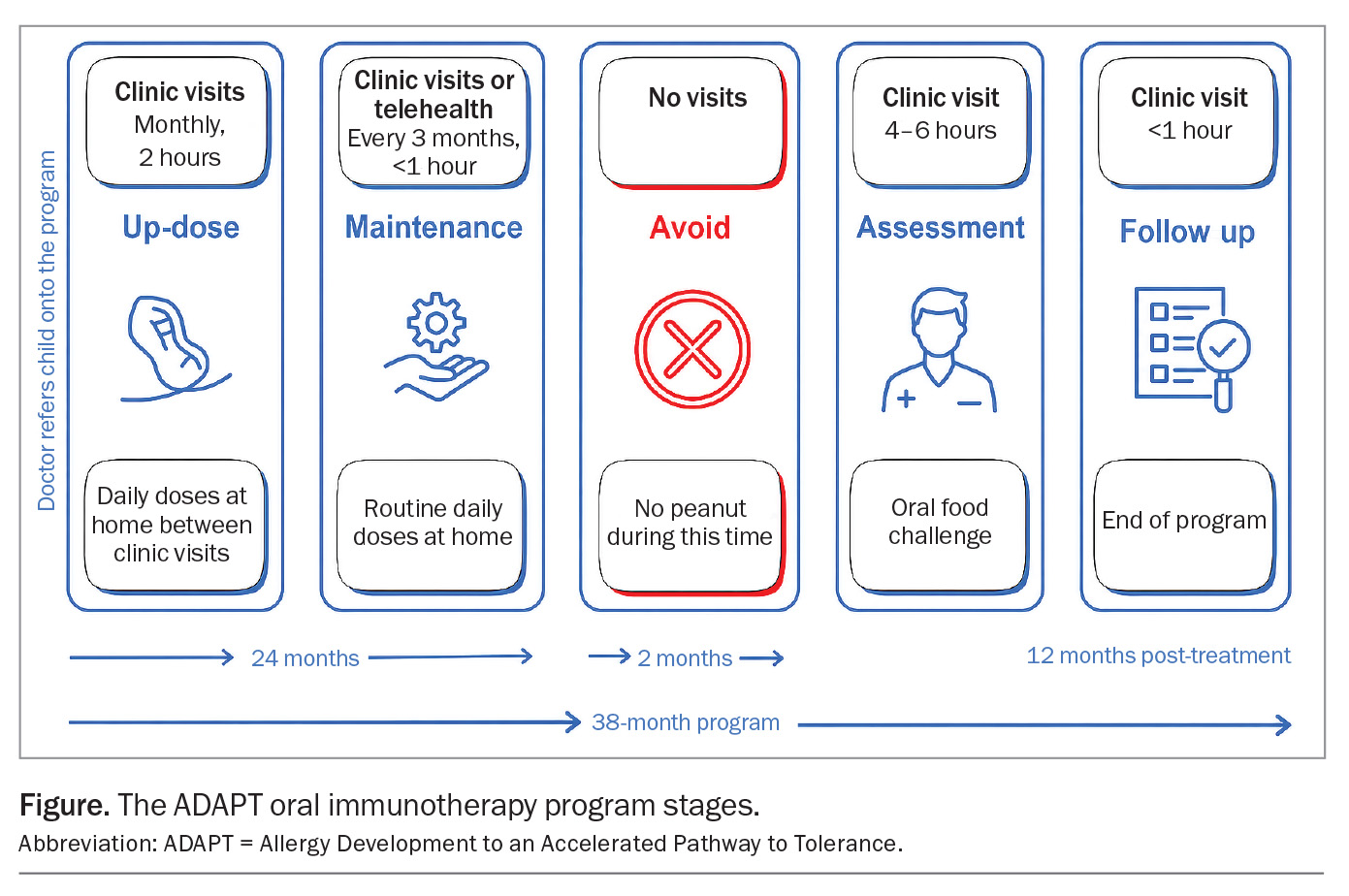
Before peanut OIT begins, a threshold oral food challenge (OFC) is performed at a participating hospital to confirm the peanut allergy diagnosis and to determine the dose at which the child first reacts. This dose then informs the OIT starting dose, minimising the number of hospital up-dose visits required and helping to individualise the program to the child. Confirming the allergy is an essential step of the ADAPT program to avoid unnecessary and burdensome treatment. For infants with a clinical history of a more severe reaction, such as anaphylaxis, an OFC is not considered necessary to confirm the allergy, and they instead proceed to start OIT via an ‘escalation OFC’ pathway, involving three small, incrementally increasing doses to determine a safe starting dose.
Each ADAPT OIT up-dose clinic visit involves a clinical review, assessment of any missed doses or reactions that have occurred at home since the last visit, supervised administration of the next higher OIT dose and a two-hour observation period. These visits carry an increased risk of reaction and are therefore performed in appropriately resourced areas of the hospital. At ADAPT OIT up-dose visits, all families are trained in measuring and administering doses at home and receive written pre- and post-dosing guidelines.
Shared decision-making and consent
Enrolment in the ADAPT program is not necessarily the best option for all infants with peanut allergy. The decision to commence OIT is made through a structured, shared decision-making conversation between the allergy specialist and the child’s family. The ADAPT program’s family information booklet, developed by NACE and the ADAPT team, guides this discussion.
Families are counselled on several key considerations:
- OIT is not a cure for food allergy, but treatment may improve the child’s chance of being able to consume peanut safely
- the ADAPT program involves a significant treatment burden: daily dosing, observation periods after each dose and regular hospital visits over several years
- allergic reactions, including anaphylaxis, may occur during OIT, particularly during the up-dose phase. Families must be equipped to recognise and manage these reactions
- an adrenaline autoinjector must always be available during the program
- the alternative standard of care remains strict peanut avoidance.
Outcomes measured
The ADAPT program prioritises the assessment of remission (sustained unresponsiveness, that is, the ability to eat peanut freely without relying on a regular daily dose) as its primary clinical outcome, rather than desensitisation alone. This decision reflects evidence that patients who achieve desensitisation but not remission have poorer health-related quality of life two years post-OIT than those who achieve remission or return to allergen avoidance.12,13 Demonstrating remission provides families with a meaningful and clear endpoint to treatment.
The role of the GP
GPs can play a practical role in supporting infants and their families through the ADAPT OIT program.
- Identification and referral. GPs are often the first clinicians to see an infant after a suspected allergic reaction to peanut. A clear history is invaluable, including timing, signs and symptoms of the reaction after eating, and foods consumed (particularly amounts consumed, if known). Prompt and thorough referral to a paediatric allergy or immunology specialist at a participating centre is essential for eligible infants to be considered. Participating centres are listed on the NACE ADAPT website (https://www.nace.org.au/research/food-allergy/). Each site may have limited capacity to provide OIT because of resource constraints.
- Adrenaline autoinjector prescribing, allergy action plans and education. All infants in the ADAPT OIT program will be prescribed an adrenaline autoinjector, and their parents will be educated on its use in accordance with the child’s ASCIA anaphylaxis action plan. ASCIA action plans can be updated on expiry and adrenaline autoinjectors re-prescribed by both GPs and paediatric allergy specialists. This is also a great opportunity to reinforce the recognition of symptoms and signs of allergic reactions including when and how to correctly use the autoinjector to treat anaphylaxis.
- Support during the ADAPT OIT program. GPs may see families during the up-dose phase, particularly if the child has an intercurrent illness or a reaction at home. Dosing guidelines are provided to families at the time of enrolment. Daily dosing should generally be paused during significant illness or fever. OIT can induce anxiety for some families, and GPs may need to support families through this or help facilitate communication with the ADAPT hospital team.
Considerations for rural and remote GPs
The ADAPT OIT program was designed with equitable access in mind. Monthly hospital visits during the up-dose phase may pose a challenge for families in rural or remote areas. Telehealth reviews are incorporated during the maintenance stage to reduce travel burden. GPs in rural and remote areas should be aware that families may need additional support in managing the logistical demands of the program.
For families in rural and remote areas who have difficulty accessing a participating ADAPT centre, referral of the infant to the nearest available paediatric allergy or immunology service remains important. NACE is exploring options with existing sites on how the program’s reach may be expanded.
For all families in rural and remote areas whose child has a peanut allergy and is not participating in the ADAPT OIT program, the GP’s role remains important in maintaining up-to-date adrenaline autoinjector prescriptions, if appropriate, ensuring families have a current ASCIA allergy or anaphylaxis action plan and educating carers and school personnel, particularly given that access to emergency care may be limited.
Information for patients and families
Parents of infants with peanut allergy commonly ask a number of important questions. GPs may refer to the following points to address these questions.
Is oral immunotherapy safe for my baby?
OIT involves deliberate exposure to a known food allergen, and allergic reactions, including anaphylaxis, may occur during the program. To minimise risk, all ADAPT program up-dose visits occur under supervision in hospitals with direct access to resuscitation equipment. Reaction rates and the safety of the ADAPT program are being closely monitored as part of the improvement science framework of the ADAPT evaluation study.
How much does it cost?
The ADAPT program is delivered as a new model of care through the public hospital system under Medicare. The only out-of-pocket cost for families is the peanut flour (about $10 for a 3-month supply). There are no additional fees.
Will my child be cured?
OIT is not a cure. The goal is remission (sustained unresponsiveness), that is, the child can consume peanut freely, even after a period of avoidance. This will be achieved in many but not all children who complete the program. Those who do not achieve remission may still benefit from an increased peanut reaction threshold (desensitisation), affording greater protection against accidental exposure.
What if we miss a dose at home?
Daily dosing is important for safety. Detailed home dosing guidelines are provided at the time of enrolment. If doses are missed because of illness or other circumstances, families should follow the guidance provided and contact the allergy clinic for advice before resuming.
Limitations
The ADAPT OIT program includes both a clinical program and evaluation study to support continuous improvement and inform future best practice. The ADAPT OIT clinical program is delivered and funded by participating hospitals, whereas the evaluation study is funded and performed by NACE. The program has been integrated into standard clinical care at the participating hospitals. However, for many participating hospitals, this has been done without the provision of additional resources, which places limitations on the number of infants who can be assessed and included in the program, because of a lack of resources. The current evaluation focuses on the cost–benefit perspective of implementing such a significant program and the overall health savings and improved quality of life may help to secure additional funding to support sustainability and growth of this innovative and collaborative program.
Conclusion
The ADAPT OIT program represents a landmark advance in the management of peanut allergy in Australia. It is the first nationally standardised, publicly funded model of care for food allergy treatment in the world, an achievement made possible through NACE, which has facilitated an unprecedented collaboration between paediatric allergy and immunology specialists, public hospital allergy and immunology departments, clinician researchers, the government and consumer advocates across the country.
The ADAPT OIT program offers a new management option for eligible infants diagnosed with peanut allergy in the first year of life. Early treatment of peanut allergy affords the opportunity to transform the lives of affected infants and their families, reducing the burden of anaphylaxis risk and dietary restrictions through a practical, evidence-based and equitable program. MT
COMPETING INTERESTS: Dr Brettig is supported by a Postdoctoral Fellowship from the Australian Government funded National Allergy Centre of Excellence (NACE), hosted by the Murdoch Children’s Research Institute (MCRI), and their work was supported by the Victorian Government’s Operational Infrastructure Support Program. Professor Perrett has received the following payments to the MCRI: grants from DBV Therapeutics, Novartis, RAPT Therapeutics, Siolta and Aravax; consulting fees from Aravax, Novartis and RAPT Therapeutics; honoraria from DBV Therapeutics; and support for attending meetings from DBV Therapeutics and RAPT Therapeutics. She is a Member of the Food Allergy Steering Committee at Novartis; an International Advisory Board Member at RAPT Therapeutics; and a non-Executive Director on the Board at Omnisova.
ACKNOWLEDGEMENTS: We would like to acknowledge the coauthors of the original paper outlining the development of the ADAPT OIT program, who were all involved in the development and implementation of this program: Brettig T, Young A, Bhatia R, Bosi I, Cheung A, Czech H, Ford LS, Katelaris CH, Lloyd M, Loke P, McDonald E, Metcalfe J, O’Sullivan MD, Peake J, Preece K, Quinn P, South C, Smart J, Swamy S, Wainstein BK, Wong M, Perrett KP. Clin Exp Allergy 2026; 56: 369-377. https://doi.org/10.1111/cea.70177
References
1. Peters RL, Allen KJ, Dharmage S, et al. Natural history of peanut allergy and predictors of persistence in the first 4 years of life: a population-based assessment. J Allergy Clin Immunol 2015; 135: 1257-1266.e1-2.
2. Peters RL, Soriano VX, Allen KJ, et al. The prevalence of IgE-mediated food allergy and other allergic diseases in the first 10 years: the population-based, longitudinal HealthNuts study. J Allergy Clin Immunol Pract 2024; 12: 1819-1830.e3.
3. Epstein-Rigbi N, Goldberg MR, Levy MB, Nachshon L, Elizur A. Quality of life of food-allergic patients before, during, and after oral immunotherapy. J Allergy Clin Immunol Pract 2019; 7: 429-436.e2.
4. Lodge CJ, Waidyatillake N, Peters RL, et al. Efficacy and safety of oral immunotherapy for peanut, cow’s milk, and hen’s egg allergy: a systematic review of randomized controlled trials. Clin Transl Allergy 2023; 13: e12268.
5. Jones SM, Kim EH, Nadeau KC, et al. Efficacy and safety of oral immunotherapy in children aged 1-3 years with peanut allergy (the Immune Tolerance Network IMPACT trial): a randomised placebo-controlled study. Lancet 2022; 399: 359-371.
6. Australasian Society of Clinical Immunology and Allergy (ASCIA). Position Paper - Oral Immunotherapy for Food Allergy 2026. ASCIA; 2026. Available from: https://www.allergy.org.au/hp/papers/ascia-oral-immunotherapy-for-food-allergy?highlight=WyJpbW11bm90aGVyYXB5Il0= (accessed June 2026).
7. Brettig TW, Young A, Bhatia R, et al. Developing a standardised national model of care for treatment of peanut allergy in infants: the ADAPT peanut oral immunotherapy program. Clin Exp Allergy 2026; 56: 369-377.
8. Chan JCK, Peters RL, Koplin JJ, et al. Fo‑od challenge and community-reported reaction profiles in food-allergic children aged 1 and 4 years: a population-based study. J Allergy Clin Immunol Pract 2017; 5: 398-409.e3.
9. Riggioni C, Oton T, Carmona L, Du Toit G, Skypala I, Santos AF. Immunotherapy and biologics in the management of IgE-mediated food allergy: systematic review and meta-analyses of efficacy and safety. Allergy 2024; 79: 2097-2127.
10. Du Toit G, Brown KR, Vereda A, et al. Oral immunotherapy for peanut allergy in children 1 to less than 4 years of age. NEJM Evid 2023; 2: EVIDoa2300145.
11. Vickery BP, Vereda A, Nilsson C, et al. Continuous and daily oral immunotherapy for peanut allergy: results from a 2-year open-label follow-on study. J Allergy Clin Immunol Pract 2021; 9: 1879-1889.e13.
12. Cao S, Borro M, Alonzi S, Sindher S, Nadeau K, Chinthrajah RS. Improvement in health-related quality of life in food-allergic patients: a meta-analysis. J Allergy Clin Immunol Pract 2021; 9: 3705-3714.
13. Loke P, Wang X, Lloyd M, et al. Two-year post-treatment outcomes following peanut oral immunotherapy in the Probiotic and Peanut Oral Immunotherapy-003 Long-Term (PPOIT-003LT) study. Allergy 2024; 79: 2759-2774.